

W450 cashews are small, white whole cashew kernels. A kilogram contains about 880–990 kernels, equivalent to 400–450 in a 454 g grading sample. W450 is a grade assigned after shelling and sorting. It identifies the size and form of the edible kernel, rather than a variety of cashew tree.
Size and Kernel Count
Within the white-whole grading system, W marks whole kernels. The number 450 comes from the upper end of the count range per pound, conventionally stated as 454 g. It does not indicate 450 kernels per kilogram.
More kernels at the same weight indicate a smaller average size. W450 kernels are therefore smaller, on average, than W320 kernels. Individual nuts still vary in weight, length and shape.
| W450 measurement | Count or weight |
|---|---|
| Whole kernels per kilogram | About 880–990 |
| Whole kernels per 454 g grading sample | 400–450 |
| Average kernel weight, calculated from the kilogram range | About 1.01–1.14 g |
The average weight is a calculation for a group of kernels. It is not a required weight for every nut. W450 also has no single fixed length in millimetres under this count-based system.
W320, W400, W450 and W500
The Indian Cashew Kernels Grading and Marking Rules, 1960, contain these whole-kernel count ranges.
| Grade | Whole kernels per kilogram | Whole kernels per 454 g |
|---|---|---|
| W320 | 660–705 | 300–320 |
| W400 | 770–880 | 350–400 |
| W450 | 880–990 | 400–450 |
| W500 | 990–1,100 | 450–500 |
W320 has the largest average kernel size among these four grades. W500 has the smallest. W450 sits between W400 and W500 in the sequence.
Some ranges share an endpoint. A count of 400 per 454 g touches both W400 and W450; 450 touches both W450 and W500. At these boundaries, the count alone does not separate the two labels. Grade ranges and permitted variations belong to the particular grading standard being used.
Whole Shape and Colour
A whole cashew kernel keeps its curved, kidney-like shape. White-whole grades include pale shades as well as white. Permitted colours vary slightly between standards, including pale ivory, light cream or light ash.
Whole does not always require a completely unchipped kernel. Under the Association of Food Industries (AFI) specification adopted in September 2023, a kernel can remain whole with no more than one-eighth missing. It must still retain its characteristic shape. This is a rule for an individual kernel, separate from the broken-kernel allowance for a batch.
Splits are kernels separated lengthwise. Butts are kernels broken across their width, with the two seed halves still joined. Smaller fragments belong to piece grades. W450 kernels retain the whole form despite their small size.
W450 and Scorched Whole Cashews
White-whole and scorched-whole grades differ in colour classification. Scorching can occur during heating or drying and darken the kernel. SW450 appears in some grading systems for scorched whole kernels in the 400–450 count range.
The shared number indicates a similar size range. The colour class remains different. Scorched grading is also separate from roasting cashews later as a snack.
The Cashew Tree, Apple and Kernel
Cashews grow on Anacardium occidentale, a tropical tree in the Anacardiaceae family. The edible kernel is its seed. A hard shell surrounds the seed, and a thin reddish-brown skin, called the testa, covers the kernel inside.
The shell-bearing nut hangs below the fleshy cashew apple. Botanically, this nut is the true fruit. The apple develops from a swollen flower stalk and is an accessory fruit. The edible kernel grows inside the nut, outside the fleshy apple.
W450 is assigned to the processed kernel. It is not a botanical variety, a growing region or a stage of ripeness. Small kernel size alone does not establish that a cashew is immature; underdeveloped and shrivelled kernels are assessed separately.
Origin and History
The cashew tree is native to tropical America, including Brazil. Portuguese traders introduced it to India during the 16th century. Its cultivation later spread across tropical parts of Asia and Africa.
The history of cashew cultivation is separate from the history of kernel grading. W450 appears in the Indian rules titled Cashew Kernels Grading and Marking Rules, 1960. That document records the grade but does not establish when traders first used its name.
Growing Regions in India
Indian cashew-growing regions include Maharashtra, Goa, Karnataka and Kerala on the western side. Andhra Pradesh, Odisha, Tamil Nadu and West Bengal also grow the crop. These regions produce raw nuts that undergo shelling and kernel grading.
India also processes imported raw cashew nuts. A kernel processed or packed in India may therefore come from a nut grown elsewhere. Growing origin, processing location and packing location are separate facts; none is encoded in W450.
Processing and Grading
Processing separates the edible seed from the shell and seed coat. Depending on the method, raw nuts receive steam or shell-roasting treatment before shell removal. Kernel drying helps loosen the testa for peeling.
| Stage | Change to the nut or kernel |
|---|---|
| Shell treatment | Prepares the in-shell nut for shelling |
| Shelling | Removes the hard outer shell |
| Drying and peeling | Loosens and removes the thin seed coat |
| Sorting | Separates kernels by whole or broken form, colour and defects |
| Sizing | Groups whole kernels by count at a set weight |
W450 is the result of sorting white whole kernels into the relevant size range. Breakage during processing produces splits, butts or smaller pieces. Cashew nut shell liquid belongs to the shell and is distinct from the oil naturally present in the edible kernel.
Plain and Roasted W450 Cashews
Plain kernels are often called raw cashews in food retail. That term does not necessarily indicate an entirely unheated product: heat may already have been used during shelling and drying. Snack roasting is a later process that changes flavour, colour and texture.
Salt and flavour coatings are also separate from kernel grading. W450 identifies the underlying whole-kernel grade, not a seasoning or recipe.
Grading Tolerances and Food Quality
Count measures size; it cannot establish every aspect of kernel quality. A 454 g sample containing 425 whole kernels fits the W450 count range. Moisture, breakage and defects remain separate measurements.
Broken Kernels and Smaller Whole Kernels
A whole-kernel grade can permit a limited amount of broken material. The allowance depends on the grading specification. The grade chart published on the All India Cashew website gives a 5% maximum for broken kernels in W450. AFI specifications for US shipments permit up to 10% broken kernels or pieces by weight in whole grades.
AFI also permits up to 10% by weight of whole kernels from a smaller size grade. Smaller whole kernels and broken pieces are separate categories. A size tolerance does not turn a fragment into a whole kernel.
Moisture and Defects
The Indian food standard for cashew kernels sets a maximum moisture content of 5% by mass. It also sets a 5% combined limit for its defined defects and unwanted matter. This second figure is not a broken-kernel allowance.
Individual limits still apply within that total. Surface damage and attached seed coat each have a 2% limit; black or brown spots have a 0.5% limit. A batch can fall below the combined total while exceeding one individual limit.
For whole kernels, free fatty acids must not exceed 1.25%, expressed as oleic acid. Peroxide value must not exceed 10 meq/kg. These laboratory measurements assess changes in kernel fats. Kernel size, colour and smell cannot provide those numerical results.
Food Uses
W450 cashews provide small whole kernels for snacks, nut mixtures and garnishes. Whole kernels remain visible in dishes such as pulao, sweets and desserts. Their size affects the number of nuts in a serving of a given weight.
Cashews can also be chopped or ground for fillings, sauces and sweets. In kaju katli or cashew paste, grinding removes the original whole-kernel shape. These uses do not depend on retaining that shape.
W450 is a size and form classification, not a separate nutritional category. The grade code does not specify protein, fat, salt or calorie content. Added oil, salt and other ingredients belong to the finished food composition.
Storage and Changes in Quality
Cashew kernels can absorb moisture and surrounding odours during storage. Damp conditions can encourage mould, while pests and rough handling can cause damage. Changes in the kernel fats can produce rancid flavours or smells.
Dry, sealed food-grade packaging helps protect kernels from moisture and contamination. Storage conditions and packaging affect how well the product keeps. W450 itself carries no fixed shelf life, packing date or freshness guarantee.
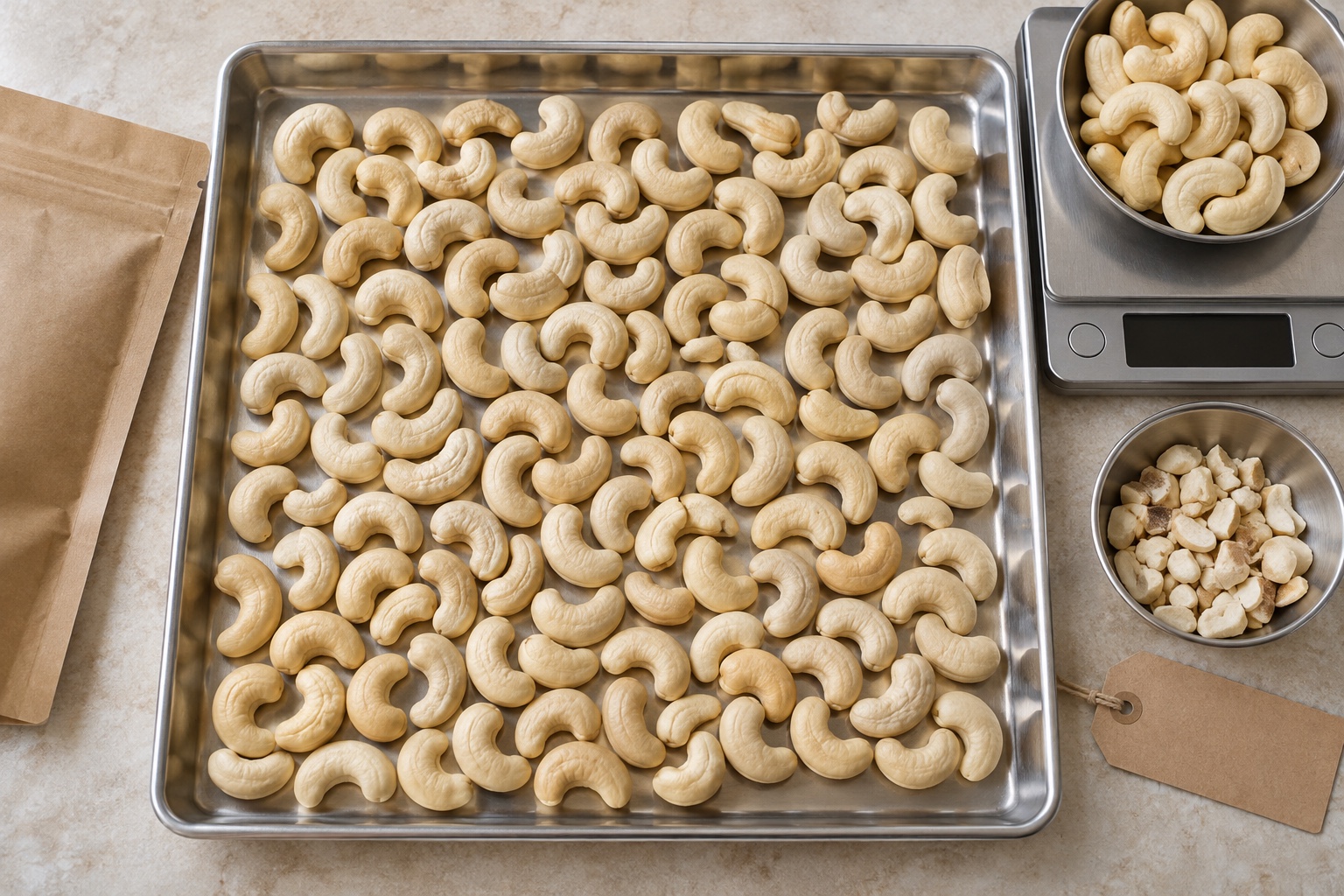
- 400–450 whole kernels per 454 g.
- Approximately 880–990 whole kernels per kilogram.
- Measure length and thickness on the actual batch.
- Illustrative photograph; appearance alone does not certify grade.
Explore the count calculation
How many kernels in 100 g?
Divide the kilogram range by 10: approximately 88–99 kernels. This is an estimate, not a replacement for the specified grading sample.