
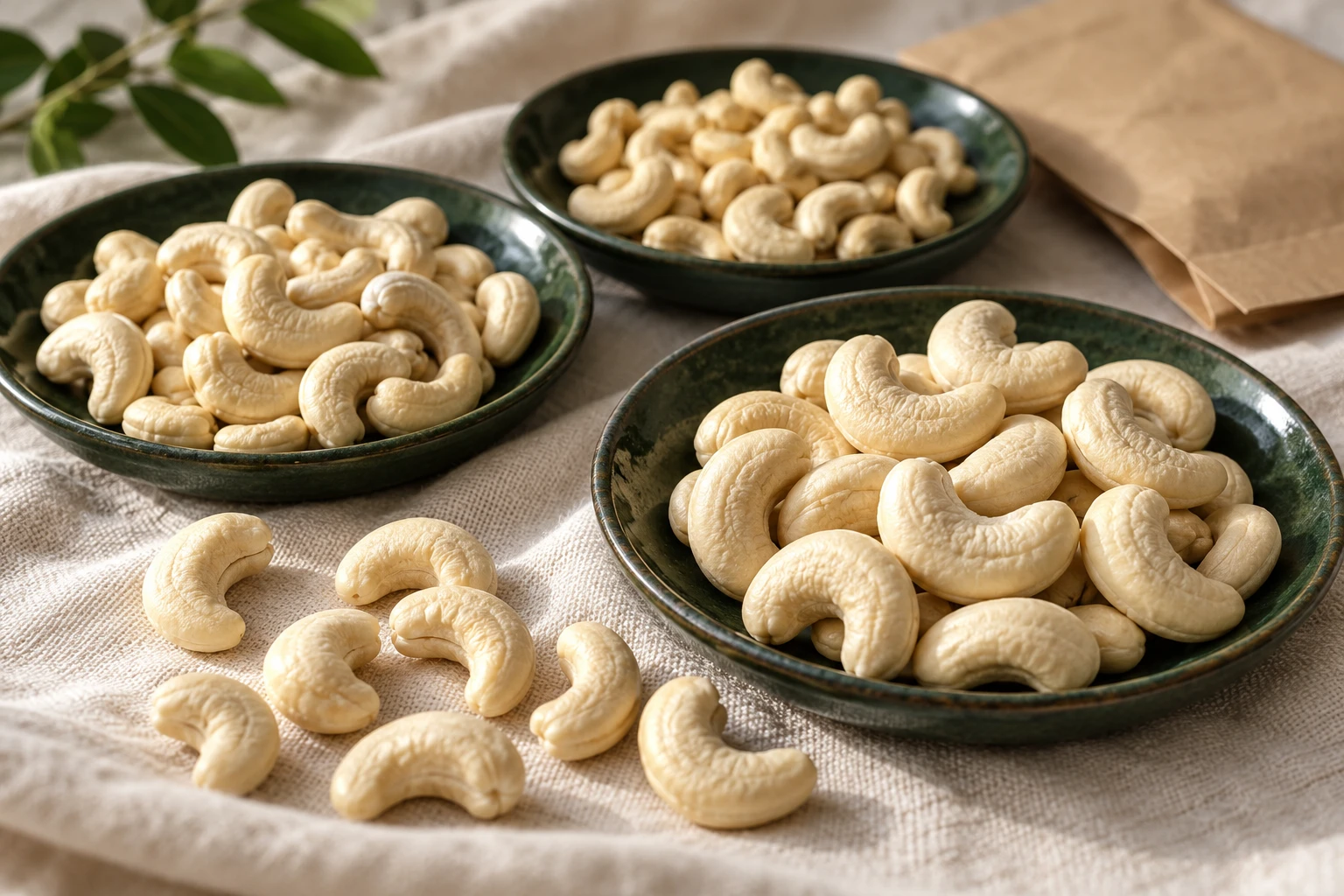
Cashew size chart: W180, W240 and W320
In the chart below, the size grade comes from counting whole cashew kernels in 454 g. A kernel is the edible cashew inside the shell. Larger cashews take fewer kernels to make up the same weight.
| Cashew grade | Whole kernels per 454 g | Relative size |
|---|---|---|
| W180 | 170–180 | Largest of these 3 grades |
| W240 | 220–240 | Between W180 and W320 |
| W320 | 300–320 | Smallest of these 3 grades |
Counts follow the CAPEX product specification; 454 g is about 1 lb.
Some grading tables use a different count range for W180. Check the count range in the quote before comparing prices. W320 does not refer to 320 cashews in a 1 kg pack. Cashews within the same grade can differ in length and weight.
W240 vs W320: which should you buy?
W240 gives larger cashews; W320 gives more individual nuts at the same weight. Compare both grades in the pack size or recipe you sell. For a counted topping, compare the cost of each cashew.
Does a larger cashew grade give better quality?
Size alone does not prove better freshness or flavour. Check the sample for colour differences and broken pieces. White whole and scorched whole are separate colour grades.
Scorched kernels have darkened from overheating during processing. W320 and SW320 can have the same count range but different colour grades. Scorched is a colour grade, not a ready-roasted product description.
Whole cashews or pieces: which form should you order?
Use whole cashews for packs that advertise whole nuts. For paste, compare cashew pieces with whole cashews in the same recipe. When buying pieces, ask for the size as well as the price.
| Form | What the description refers to |
|---|---|
| Whole kernels | Cashews that retain the whole shape. Some grades permit small chips. |
| Splits | Lengthwise halves of a cashew kernel |
| Butts | Kernels broken across the width |
| Pieces | Small or large fragments of cashew kernels |
Cashew form definitions: AFI specifications.
Use the same cashew weight, recipe and equipment for each trial. Compare the flavour, colour and smoothness of the finished food. Record any extra grinding time or preparation the pieces need. Add any extra grinding cost before comparing the total cost.
Calculate the cashew cost for the product you sell
Compare the cashew cost per finished pack, sweet or batch. A fixed-weight pack keeps the same nut weight across grades. A topping of 1 cashew changes weight with kernel size. Sorting out broken pieces reduces the whole-cashew weight available for packing.
Retail packs: calculate cost after sorting
For whole-cashew packs, calculate cost from the quantity left after sorting. A 250 g pack contains the same cashew weight, whichever grade you choose. Larger cashews give fewer nuts in the same pack weight. Check that the cashew size matches the description on your pack.
If no cashews need removing, 1 kg fills 4 packs of 250 g. The cashew cost per pack is the kilogram price ÷ 4. After removing pieces, weigh the cashews left for those packs.
If removed pieces have no other use or value, include the loss in your pack cost. Calculate the cashew cost per 250 g pack as: purchase cost ÷ usable cashew weight in grams × 250. Record the weight of pieces used in other foods separately, so the full purchase cost is not charged to both uses.
Toppings: calculate the cost of 1 cashew per sweet
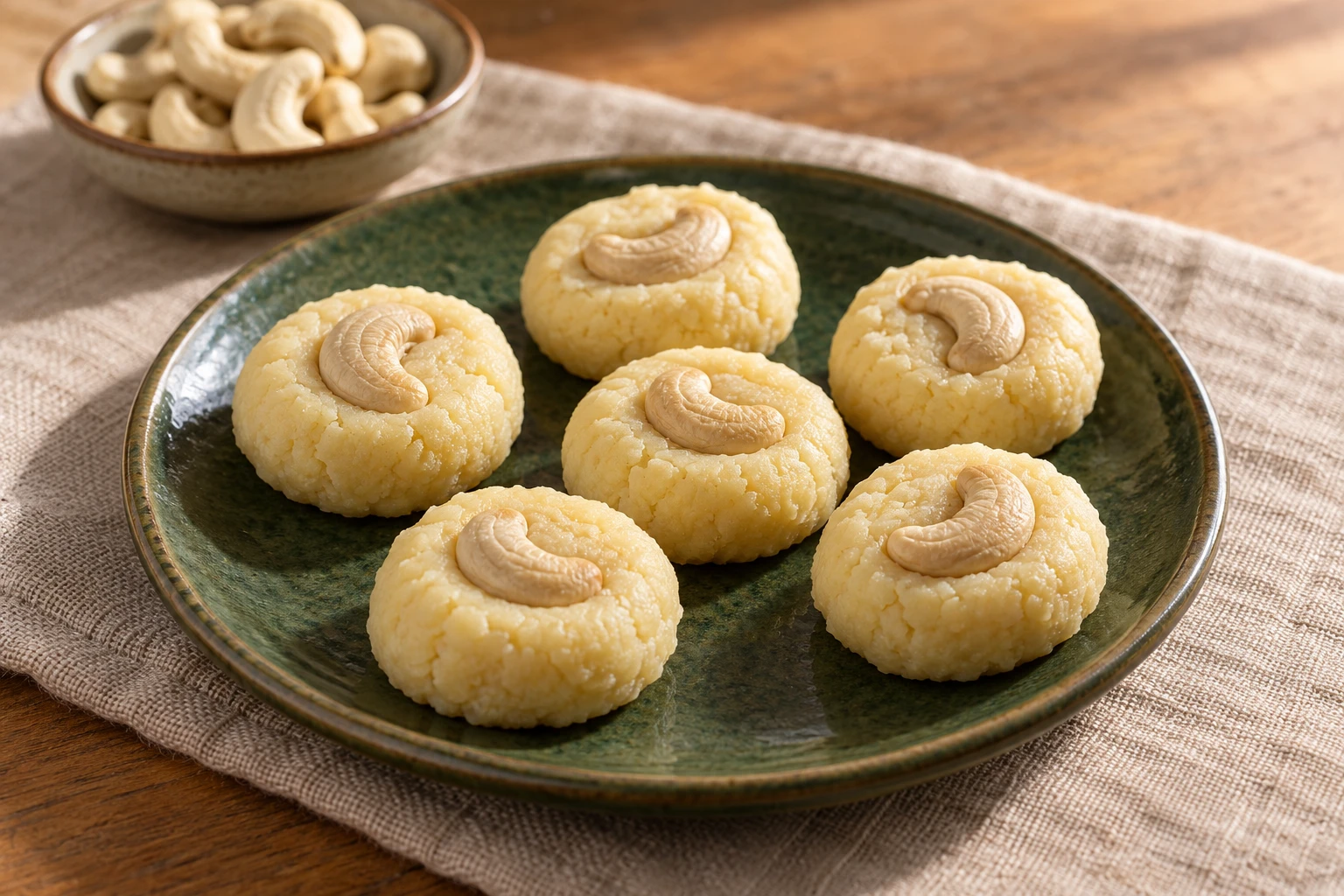
Calculate each topping cost from kernel weight and price per kilogram. With 1 cashew per sweet, larger nuts increase the cashew weight you use. Decide if that larger topping justifies the extra cashew cost.
A worked topping example
Suppose 100 whole kernels from your sample weigh 200 g. You need 2 kg for 1,000 sweets using 1 cashew each, before losses. At an example price of ₹1,000 per kg, those cashews cost ₹2,000. That adds ₹2 of cashew cost to each sweet.
- whole kernels
- 100
- sample weight
- 200 g
- cashew cost per sweet
- ₹2
Use your actual sample weight and quoted price for this calculation. Allow extra for cashews that break or need removing during preparation. The 100-kernel check estimates how much cashew your recipe needs. This weighing exercise does not confirm the grade of the full delivery.
Roasted snacks: compare the finished batch
Choose the grade after testing it with your roasting method. Roasting can change cashew colour, texture and taste. Use equal batch weights with the same temperature, time and seasoning for the first comparison.
After cooling, check the cashews for flavour, colour and crunch. If you change the roasting time or temperature, record the change. Compare the roasted samples again after changing the settings. Include any extra preparation cost when comparing the quoted prices.
What should you compare in 2 W320 quotes?
Compare the allowed percentages of broken pieces, smaller whole kernels and colour defects. 2 W320 quotes can allow different amounts of broken pieces. Ask each supplier to state the limits in the written quotation.
Compare equal pack weights and the same type of cashews. Confirm if each quote covers unroasted, roasted or salted cashews. Also check any packing charges included in the quotation.
How much broken cashew can a whole grade contain?
The permitted percentage comes from the grade rules agreed for your order. Whole-cashew grades can allow some separate broken pieces. Some grade rules allow small chips on otherwise whole kernels.
Measure broken pieces as a percentage of the total sample weight. For example, 50 g of pieces in a 1,000 g sample equals 5%. Counting 5 pieces out of 100 does not give the weight percentage. Individual nuts and pieces have different weights.
The 5% figure is an example, not a limit for every order. Record smaller whole kernels separately from broken pieces. Use the agreed grade rules to separate whole kernels from pieces before calculating the percentage.
How do you check that the sample matches your delivery?
Match the sample batch number with the batch listed for your delivery. A batch number identifies a group of cashews from the supplier. Keep the sample label or reference number with your order. If the supplier changes the batch, ask for a sample from the replacement.
Agree a sampling plan for checking the delivery. The plan states which packs to check and how much to take. A handful chosen for appearance cannot confirm the condition of the full delivery.
Look for size variation, colour differences and broken pieces. Moisture is the water content of the cashews and needs a separate test. If your order specifies a moisture limit, ask for the result. Check the product name, batch number, test date and result. A report from another batch cannot confirm the condition of your delivery.
What should the cashew description on your order include?
Record the grade, count range and broken-piece limit. State if you need unroasted or roasted cashews. For example, write “white whole cashews, W240, 220–240 kernels per 454 g.” Include the sample reference and the rules for checking the delivery.
Add the pack weight and any requirements for salt or seasoning. If you require Indian-grown cashews, include that condition in the order. Keep this description with the order confirmation for delivery checks and repeat orders.
Grade names and where the cashews grew
Are W320 and WW320 the same?
Both labels can refer to white whole cashews in the 320 size class. Confirm that both suppliers quote white whole kernels. Compare the count range and broken-piece limit in the written offers.
Does processing in India confirm where the cashews grew?
Processing in India does not confirm where the cashews grew. India also processes imported raw cashew nuts. For an Indian-grown claim, ask for written confirmation of the growing country.
Get a quote for the cashews you need
Tell NutDana the grade you need or the product you make. Ask about available cashew grades, pack sizes and wholesale prices in India. Include the quantity you need for your next order.