

W400 cashews are white whole kernels graded by size. The older Indian grading range is about 770–880 whole kernels per kilogram. That corresponds to 350–400 whole kernels in a 454 g sample.
The 350–400 Kernel Range
W identifies whole kernels in this grading system. The number 400 marks the upper limit for a 454 g sample. It does not indicate 400 kernels per kilogram.
The count measures a group of kernels at a set weight. Individual nuts can differ in length, width and weight. The grade sets a kernel count, not a fixed length.
Average Weight of One Kernel
The kilogram range gives a calculated average of about 1.14–1.30 g per kernel. Dividing 1,000 g by 880 gives about 1.14 g. Dividing by 770 gives about 1.30 g. Individual kernels can weigh more or less than the group average.
Rounded Counts per Kilogram
The 454 g grading unit represents approximately 1 pound. The older Indian schedule gives rounded kilogram counts alongside this unit. For example, 350 kernels in 454 g converts to about 771 per kilogram. The schedule prints 770 as the lower limit.
W400 Between W320 and W450
W320 kernels have a larger average size than W400. W450 kernels have a smaller average size. More kernels fit into the same weight as their average size decreases.
| Grade in the older Indian schedule | Whole kernels per 454 g | Whole kernels per kilogram |
|---|---|---|
| W320 | 300–320 | 660–705 |
| W400 | 350–400 | 770–880 |
| W450 | 400–450 | 880–990 |
The Gap Between 320 and 350
The W320 range ends at 320 kernels per 454 g. W400 begins at 350, leaving a gap between the two ranges. A sample containing 335 whole kernels falls outside both stated ranges.
The Shared Count of 400
W400 and W450 both include 400 whole kernels per 454 g. At that shared count, the number alone cannot distinguish the two grades.
Grading Systems Without W400
The Association of Food Industries specification adopted in September 2023 uses size codes 320 and 450. Its size table has no separate 400 code. The All India Cashew website chart also omits W400.
AFI gives 300–320 kernels per pound for size 320 and 400–450 for size 450. The Indian industry chart uses matching ranges per 454 g. Neither provides a separate category for the older Indian 350–400 range.
A sample containing 375 kernels fits the older W400 range. It falls outside the stated ranges for 320 and 450. The missing W400 row therefore concerns these particular charts, not every grading system.
Indian Records of the W400 Grade
The Cashew Kernels Grading and Marking Rules, 1960 include W400 in Schedule I. The Indian Standards Institution later adopted IS 7750:1975 on 31 July 1975. That standard also includes the W400 count range.
The 1975 foreword records continued use of pounds in international cashew trade. This accounts for its inclusion of both kilogram and pound counts. These records do not establish when traders first used W400.
A later edition, IS 7750:2013, revised the Indian cashew-kernel standard. Requirements from the 1975 edition belong to that earlier version. They cannot establish the requirements of later editions.
Whole Shape and Pale Colour
The older Indian W400 grade requires the curved shape of a cashew kernel. Permitted colours include white, pale ivory and light ash. White whole therefore includes pale shades as well as white.
The specification also requires kernels free from attached testa, the thin seed skin. It excludes damaged kernels and black or brown spots. These requirements concern the kernels themselves, separate from their count.
Splits are kernels separated lengthwise, while butts break across the kernel. Both belong to broken-kernel categories rather than whole-kernel size grades. Matching a count with fragments does not make those pieces W400.
The 1975 Rule for Broken and Lower-Grade Kernels
IS 7750:1975 sets one combined allowance for broken kernels and kernels of the next lower grade. Together, their weight must not exceed 5% at packing. This limit applies to the 1975 edition.
In a 1 kg example, that combined limit equals 50 g. Broken kernels could account for 30 g of the allowance. Another 20 g could consist of kernels from the next lower grade. Each category does not receive a separate 50 g allowance.
The rule measures weight, rather than the number of affected kernels. Many small fragments can weigh less than a few whole kernels. Counting pieces therefore cannot replace weighing them.
Kernel Count and Recovery from In-Shell Nuts
W400 counts edible kernels after shelling and peeling. Raw-nut count measures complete nuts with their shells attached. These measurements concern different stages of cashew processing.
Kernel out-turn is the amount of usable kernel recovered from in-shell nuts. The trade expresses it as pounds of usable kernel per 80 kg of raw nuts. That recovery figure is separate from the W400 size count. W400 does not state how much usable kernel a batch of raw nuts will yield.
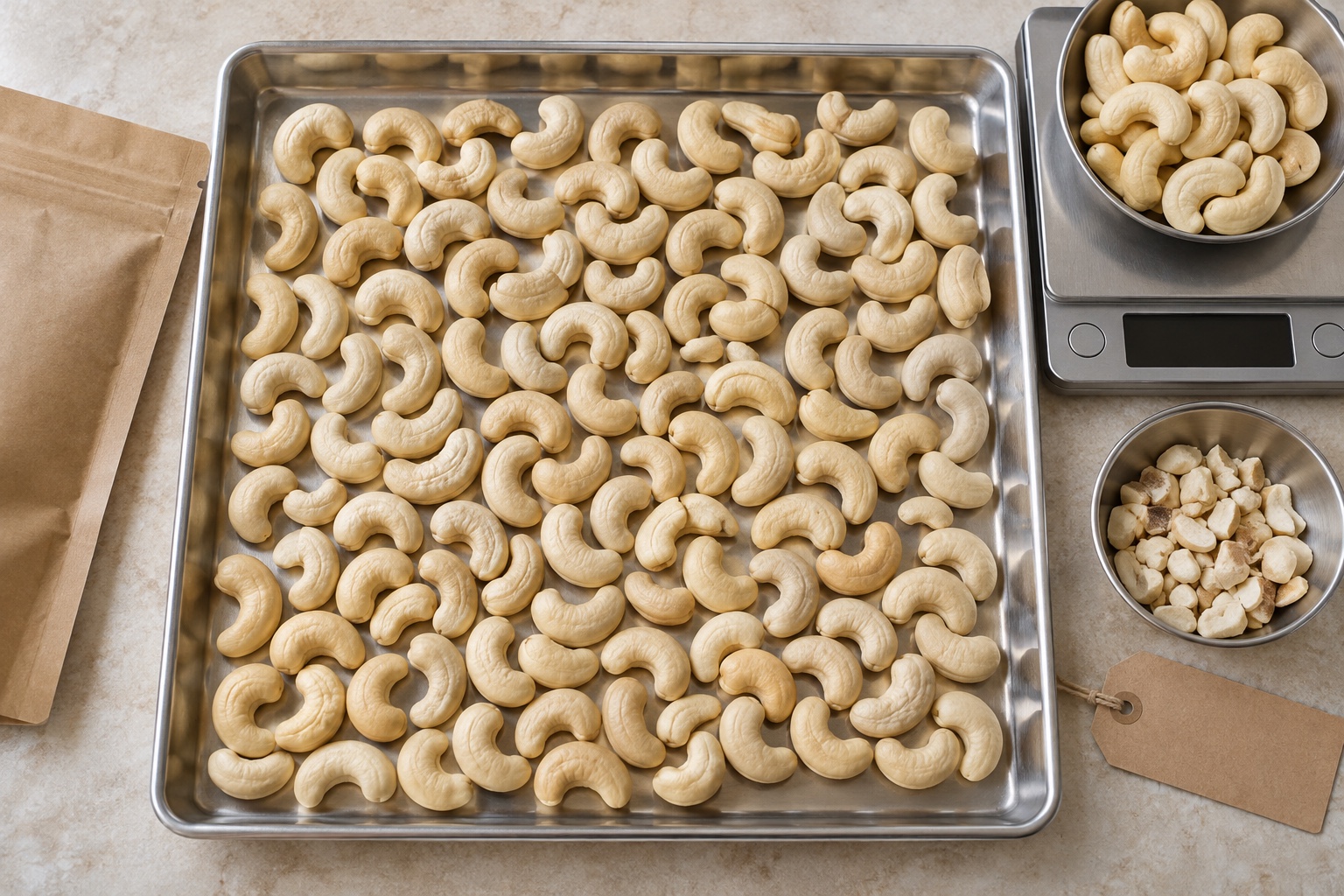
- 350–400 whole kernels per 454 g.
- Approximately 770–880 whole kernels per kilogram.
- Measure length and thickness on the actual batch.
- Illustrative photograph; appearance alone does not certify grade.
Explore the count calculation
How many kernels in 100 g?
Divide the kilogram range by 10: approximately 77–88 kernels. This is an estimate, not a replacement for the specified grading sample.