

What are W180 cashews?
W180 describes white whole cashews sized by kernel count. A kernel is the edible cashew after shell removal. White describes the colour; whole describes how much of the kernel remains intact. The number 180 gives the upper kernel count per pound.
You may see W180, W 180 or WW180 on quotes.
How many W180 cashews are in 1 kg?
At 170–180 kernels per 454 g, 1 kg contains approximately 374–396 whole cashews. These estimates use the weight of whole kernels only.
| Whole-kernel weight | Approximate count |
|---|---|
| 50 g | 19–20 |
| 100 g | 37–40 |
| 250 g | 94–99 |
| 500 g | 187–198 |
| 1 kg | 374–396 |
These are calculated estimates, not guaranteed counts in every pack. Pieces reduce the weight available as whole kernels in a pack.
For another weight, calculate both ends of the range:
- Lower estimate: 170 × whole-kernel weight in grams ÷ 454.
- Upper estimate: 180 × whole-kernel weight in grams ÷ 454.
Why count ranges differ
A specification sets out the written grading requirements for an order. Different specifications can set different count limits.
The United Nations Economic Commission for Europe (UNECE) sets size-180 limits. Under its size-180 count limits, the maximum is 395 kernels/kg. The 374–396 estimate comes from converting 170–180 kernels per 454 g.
Agree the count rule and units before testing a sample.
W180 length, width and thickness
W180 has no single fixed length, width or thickness. The grade uses kernel count for a given weight.
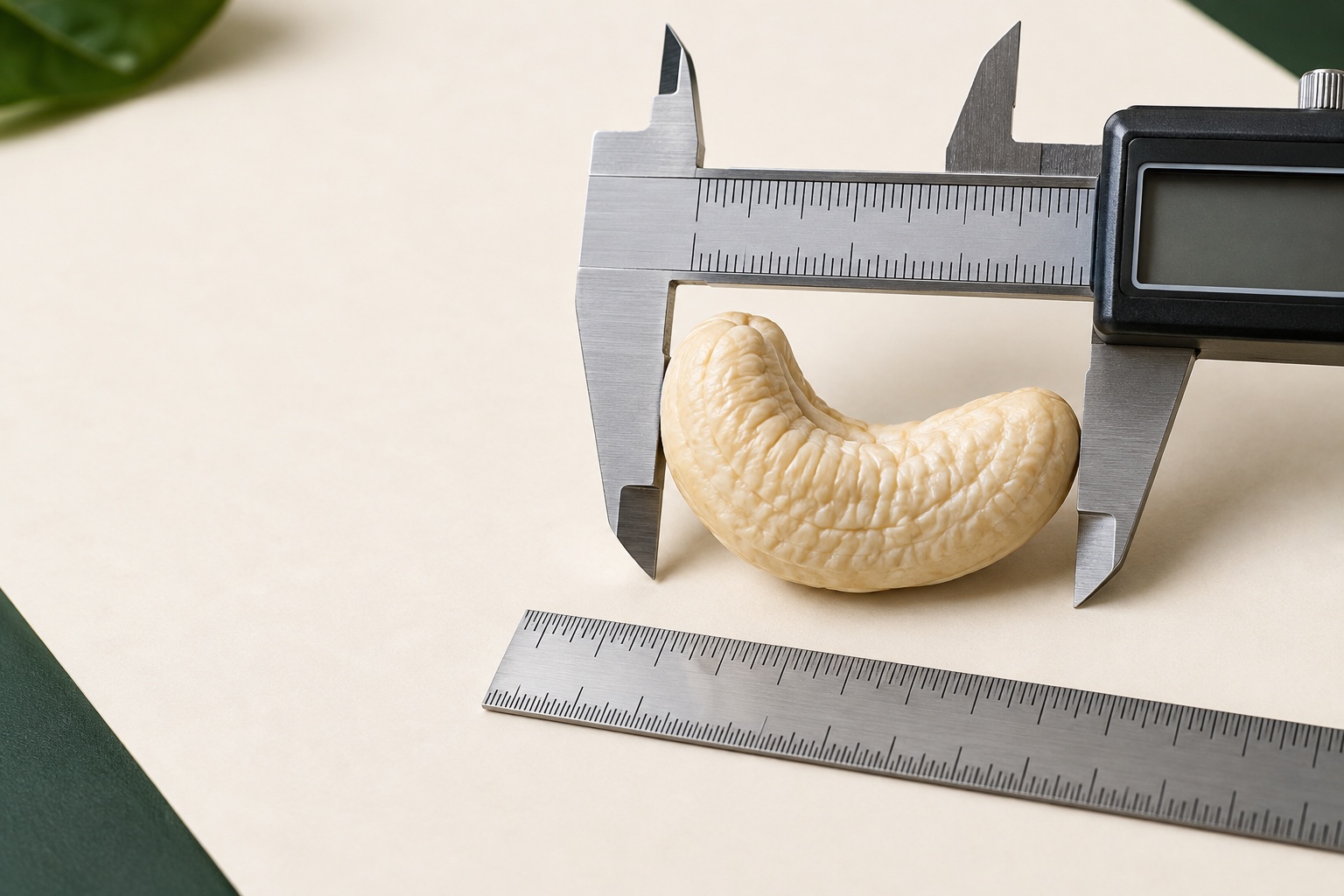
W180 study-sample averages
These are study-sample averages, not mandatory W180 grade limits. Measure the batch sample for a dimension your product requires.
A 2015 sample of W180 kernels averaged 26.3 mm long, 18.1 mm wide and 13.3 mm thick. These measured W180 dimensions came from kernels with 5% moisture on a dry basis. Here, 5% dry-basis moisture represents 5 g water per 100 g dry material. These are experimental averages, not required W180 dimensions.
In the same experiment, W210 kernels averaged 26.1 mm long. A ruler alone cannot identify these two count grades.
The UNECE chart includes size 150, so W180 is not the largest possible whole-cashew grade.
W180 vs W210, W240 and W320
Within the same count system, a lower number identifies larger average whole kernels. The commercial count ranges per 454 g below come from the All India Cashew Convention grade chart. Average weights are calculated from those ranges.
| Grade | Kernels per 454 g | Calculated average weight per kernel (g) |
|---|---|---|
| W180 | 170–180 | 2.52–2.67 |
| W210 | 200–210 | 2.16–2.27 |
| W240 | 220–240 | 1.89–2.06 |
| W320 | 300–320 | 1.42–1.51 |
Equal numbers of kernels do not give equal weights. Under these ranges, 20 W180 kernels weigh about 50–53 g. The same number of W320 cashews weighs about 28–30 g.
Size variation within a W180 batch
The same W180 sample can contain kernels of different sizes. Check the limit for whole kernels below the ordered size grade, including the percentage basis.
Assume 90 kernels weigh 2.6 g each. Another 10 smaller kernels weigh 2.0 g each. The sample weighs 254 g in total. The smaller kernels represent 10% by number, but about 7.9% by weight.
The Association of Food Industries (AFI) permits up to 10% lower-size whole kernels by weight. This is an AFI trade limit, not an India-wide legal limit.
Colour, skin and surface damage
Colour, remaining skin and surface damage need separate checks.
White colour and heat-darkened kernels
The white category allows shades such as pale ivory and light yellow. Check that the batch has a consistent colour within the permitted shades.
W180 and SW180 can use the same count range. SW describes whole kernels darkened by processing heat, called scorched whole in trade. Compare the colour description as well as the size number.
A photo can show colour. It cannot confirm freshness or identify the cause of discolouration.
Natural openings, skin and damaged areas
A natural end opening or central crack is not automatically a defect under the UNECE definition. Check detached pieces and insect damage separately.
| Feature | What it describes |
|---|---|
| Natural end opening or central crack | An opening at the kernel end or along its centre |
| Remaining skin, called testa | Skin attached to the edible kernel |
| Loose skin | Skin no longer attached to the kernel |
| Hard shell fragment | A piece of the outer shell |
| Scraped surface or deeper cut | A scraped area or cut; deeper cuts can change the kernel shape |
| Spots or discoloured areas | A spot or area with a different colour |
| Detached halves or pieces | Broken material, rather than a surface mark |
The AFI whole-kernel definition allows a whole kernel to have up to 1/8 broken off. This allowance concerns individual kernels; broken pieces within a pack have a separate limit.
An allowance for broken pieces does not cover mould, rancidity or foreign material. Rancidity is an unpleasant smell or flavour caused by changes in the oil. Foreign material includes shell fragments or stones.
Moisture and kernel weight
Water changes kernel weight without adding dry cashew material. Moisture content is the amount of water measured in the sample.
Wet-basis moisture compares water weight with total sample weight. At 3% wet-basis moisture, a 1 kg sample contains 30 g water. The other 970 g is dry material. Dry-basis moisture compares water weight with dry material weight.
Keep the dry material unchanged at 970 g. At 5% wet-basis moisture, the sample weighs about 1,021 g. The extra weight comes from water. These numbers illustrate a calculation, not a measured NutDana batch.
Touch or crunch cannot provide a moisture percentage. If moisture is an order requirement, check the measured result.
Moisture content and water activity
Water activity indicates how readily water can support bacterial and mould growth. You cannot convert a moisture percentage directly into a water-activity reading. Check the test method and temperature alongside the water-activity result.
Low water activity does not prove that food contains no harmful microbes.
Origin and processing of W180 cashews
W180 identifies a grade, not a growing location or processing method. Growing, processing and packing can take place in different locations. The Indian variety Bidhan Jhargram-2, developed in West Bengal, can produce W180 kernels.
Plain kernels can receive heat treatment before roasting for a snack product. Cashew processing can involve heating or steaming before shell removal and peeling. In-shell nuts retain the shell. Processing removes the shell and skin to produce plain kernels.
Taste and nutrition compared with smaller grades
W180 does not guarantee sweeter flavour or more oil per 100 g. Larger kernels weigh more per piece, so compare nutrients per 100 g rather than per kernel.
Use equal weights of cashews with the same preparation. Added salt, oil or coatings change the finished product. Compare flavour using the actual batches.
When to use W180 cashews
W180 suits products where a large whole cashew remains visible, including snack packs, gift packs and toppings. For a sweet with one cashew on top, count the intact kernels. For a pack sold by weight, compare equal net weights.
For paste, grinding breaks down the whole kernel. Test equal weights of pieces and whole kernels that meet the recipe requirements.
Cost per usable whole cashew
If each item needs a whole cashew, compare cost per usable kernel. Count only kernels intact enough for their intended use. A topping may need a completely intact cashew even if a trade grade permits small chips.
Cost per usable whole cashew = purchase cost for 1 kg ÷ usable whole kernels in that kg
Assume intact kernels average 2.60 g each in this example. Measure broken pieces as a percentage of the purchased weight. The average kernel weight stays the same in all three rows. The calculation assumes all unbroken material is usable.
| Broken material by weight | Weight available as whole kernels (g) | Approximate usable whole kernels |
|---|---|---|
| 0% | 1,000 | 385 |
| 5% | 950 | 365 |
| 10% | 900 | 346 |
These are calculated examples, not NutDana breakage rates. The calculation does not deduct any money recovered from using or selling the pieces.
Compare quotes from the same date or pricing period. Match order quantity, preparation, net weight, packing and delivery charges.
How to inspect a W180 sample
Compare the sample with the count, colour and breakage terms agreed for the order. Identify the batch and preparation, such as plain or roasted, before taking measurements. Take portions across the batch under the agreed sampling method.
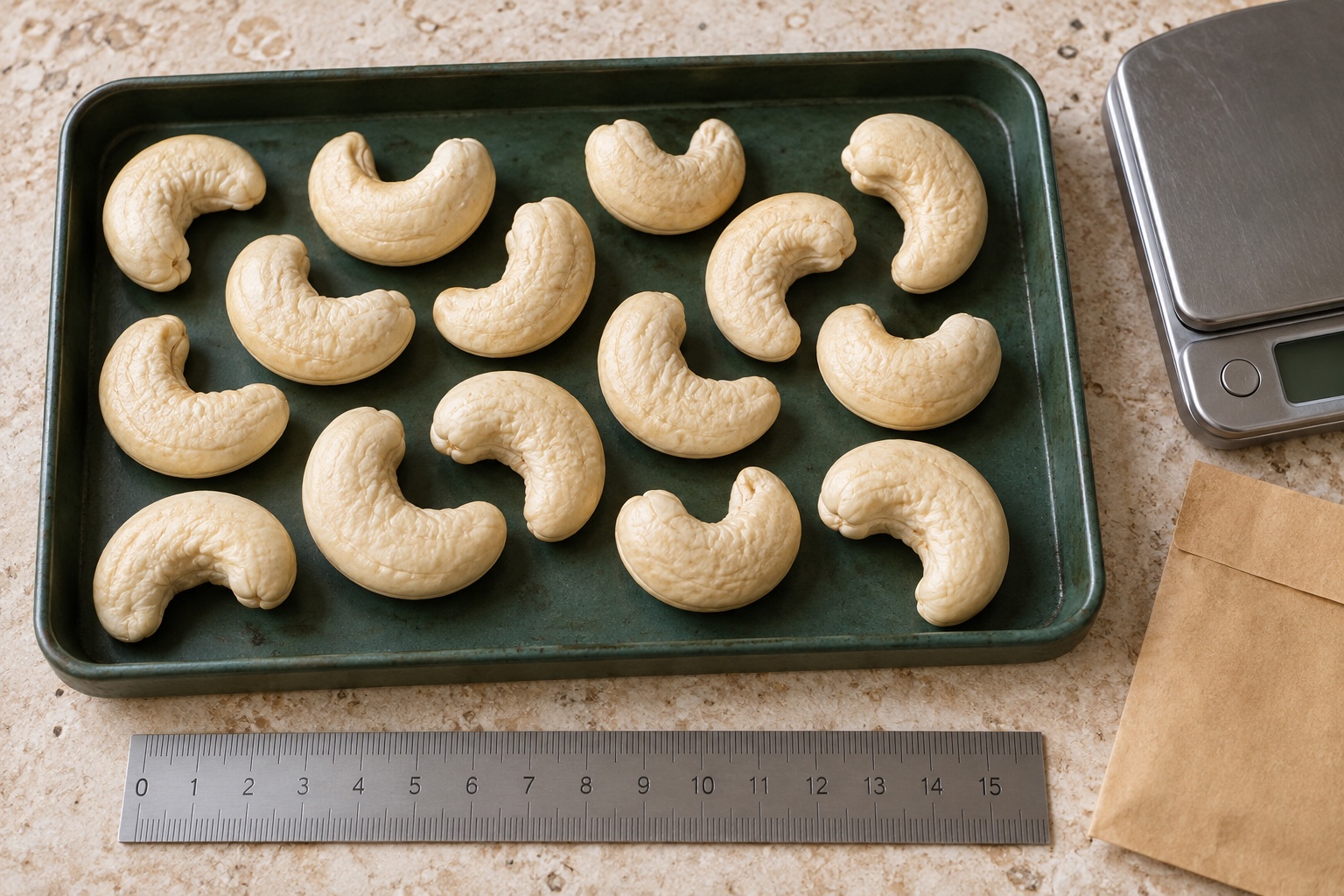
- Match the delivery batch code.
- Count whole kernels in the specified weight.
- Weigh broken pieces separately.
- Record colour, defects and the method used.
Count, smaller kernels and broken pieces
Measure whole-kernel count, broken pieces and the percentage of smaller kernels separately. Record sample weights and state if percentages use weight or kernel count.
The AFI grade-testing method uses 454 g for whole-kernel count. It checks breakage in a 1,000 g sample. Defects and size assessment each use a 500 g sample. These sample weights follow the AFI method for U.S. trade.
Broken material (%) = broken-material weight ÷ total sample weight × 100
For example, 50 g of pieces in a 1,000 g sample represents 5% broken material by weight. That calculation does not set the permitted limit for an order.
A count of 19 kernels in 50 g converts to 380/kg. A count of 20 kernels in 50 g converts to 400/kg. One additional kernel changes the estimate by 20/kg. Neither 50 g sample alone proves the grade of a delivery.
If a result falls outside the agreed limit, identify the affected batch. Keep that batch separate while you review the failed check with the supplier.
Colour before and after roasting
Use the same lighting when comparing colour. Roasting can reveal spots or paler scraped areas that were less apparent in plain kernels.
Record the batch code, sample weight, temperature and roasting time. Use the same equipment and process for each comparison. Compare surface colour and how many kernels remain whole after roasting. For a contract roast test, follow the agreed method.
A roast-colour test does not prove that the batch is safe to eat. Do not taste food with suspected mould, contamination or spoilage.
Packing and condition on arrival
Inspect the sealed packaging when it arrives. Record the kernel condition when you open the pack, before separating any stuck kernels.
Blocking describes kernels sticking together in a firm mass. Packing conditions and moisture can contribute to blocking, but appearance alone cannot show the cause. Separating the block may break kernels and change the whole-kernel count. Record any breakage caused during separation.
When the delivery arrives, check:
- Seal damage or signs of leakage.
- Visible damage to the packaging.
- Net weight, excluding packaging.
- Loose kernels or kernels stuck together.
The weight of a sealed pack includes its packaging. Do not compare that gross weight directly with the declared net weight.
Batch codes, dates and test reports
Match the report batch code to the pack labels. Then check what the report measured, the result and its unit.
A product specification describes the grade, preparation and quality limits. A certificate of analysis (COA) gives test results for the sample named in the report. Test reports can include moisture, oil quality and checks for harmful microbes.
Check the report for:
- Product and preparation, such as plain, roasted or salted.
- Batch code matching the identifier printed on the pack.
- The sample tested.
- Sampling and testing dates, where available.
- Results, units and stated limits.
- Test methods and report issuer.
Keep harvest year, processing date and packing date separate. A recent packing date does not prove a recent harvest. If the supplier claims organic certification or treatment against harmful microbes, request separate records.
Storage and shelf life
Keep packs away from moisture, heat and strong smells. Use the storage instructions and dates supplied with the batch.
W180 does not set a fixed expiry period. Product condition, packaging, temperature and opening the pack affect storage life.
After opening, reseal the pack or use a clean, dry container suitable for food. Copy the batch code and original dates onto the new container. Record the opening date separately from the original expiry or best-before date. Follow any shorter time limit given for an opened pack.