
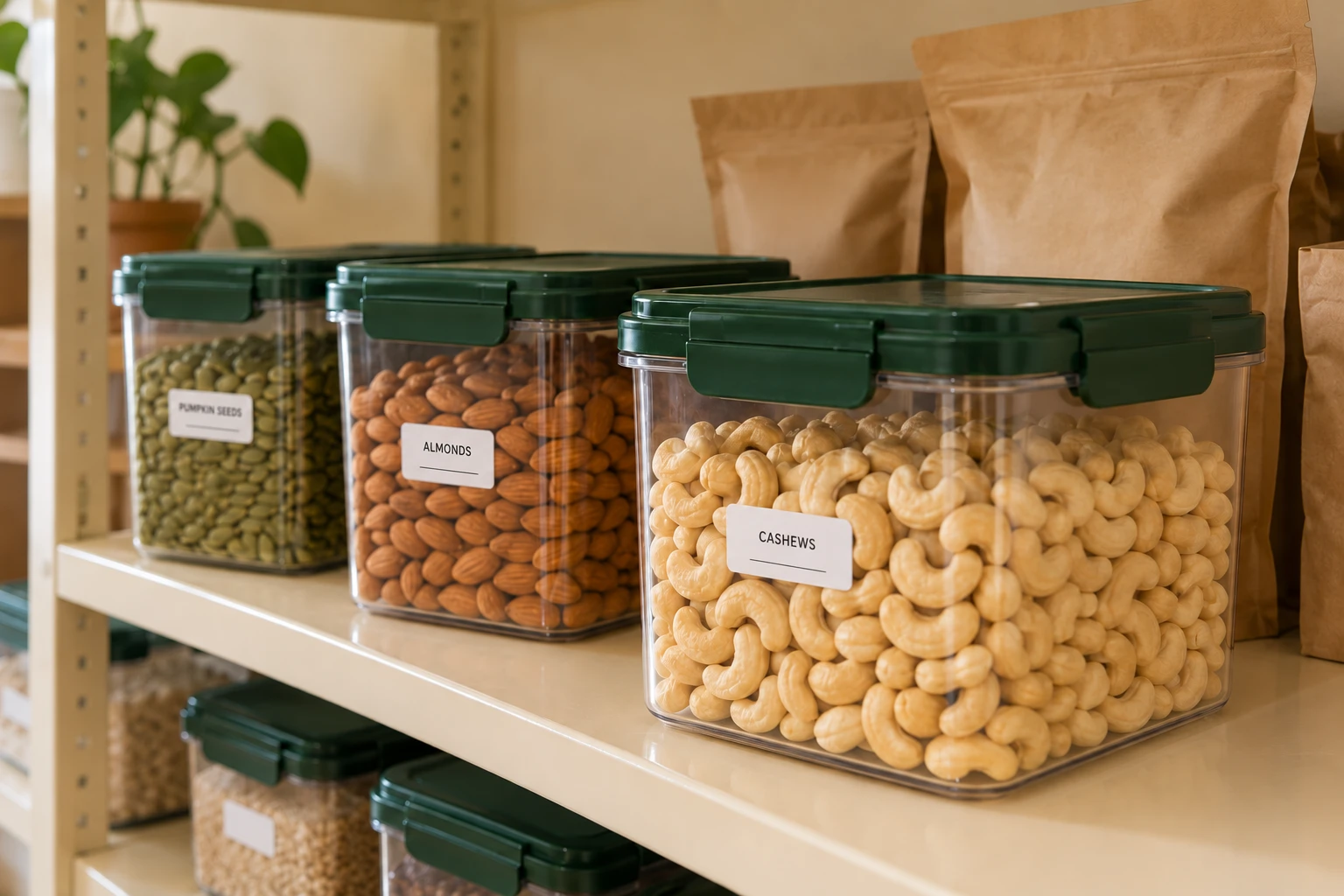
Inspect packs and labels when the delivery arrives
Inspect the inner packs before putting the delivery into storage. Look at the seals, then match the labels with your order. An undamaged outer carton can still contain a torn inner pack.
- Seals: Look for tears, punctures and broken closures.
- Cartons: Note damp patches, crushing and signs of insects.
- Product: Match the product name and pack size with the order. Confirm whole nuts, pieces or roasted products where relevant.
- Records: Retain the batch code, printed dates and storage instructions.
A batch code identifies the production batch. Copy the code onto the container label before transferring food. If a pack has damage, set it aside before transferring the contents. Photograph visible damage and retain the packaging and invoice for supplier review.
Measure temperature and humidity before storing the packs
Compare the storage conditions with the instructions for the product. Use a thermometer and humidity meter where you intend to keep the packs. Humidity is moisture in the air. Measure during warmer or wetter periods too, since one morning reading may miss later conditions.
An airtight container cannot make a hot room suitable for every product. Use the supplied instructions to choose room storage or refrigeration. If the label only says cool and dry, ask the supplier for temperature and humidity limits.
Cut and roasted almonds need more protection against moisture and oxygen. Do not copy whole-nut storage instructions onto a sliced or roasted product. Identify the supplied form before choosing the storage space and packaging.
| Products | What to confirm before choosing storage |
|---|---|
| Almonds and cashews | Identify whole nuts, slices or pieces and raw or roasted forms where relevant. A cashew size grade alone does not establish shelf life. |
| Walnuts and pistachios | For California walnuts, commercial guidance lists 0–5°C and 65% relative humidity for storage up to 6 months. Do not use this period to extend a pack expiry date. Ask for the storage conditions for the supplied pistachios separately. |
| Dates and raisins | Identify the variety and its storage instructions. Soft dates and chewy raisins can be normal, but texture alone cannot confirm safety. |
| Pumpkin and sunflower seeds | Distinguish raw and roasted kernels. Vacuum packing does not remove the need for suitable temperature conditions. Follow the instructions for the supplied product and pack. |
| Chia and flax seeds | Confirm whole or ground flax and the conditions after opening. Use the instructions for the supplied chia pack. Do not copy storage advice for flax oil onto seed packs. |
Keep packs away from sunlight, cooking steam and cleaning chemicals. Store packs off the floor, with room for cleaning and pest checks. During monsoon, look for leaks, damp cartons and moisture near washing areas. If readings exceed the specified limits, choose a location that meets those limits.
Store opened packs for daily use
Record the opening date separately from the original printed dates. Label each working container with the product name and batch code. Include the dates and storage instructions in the container record.
Keep the batch number when you change the container.
Reseal opened packs or use airtight containers
Keep the original pack if it reseals as intended and meets the after-opening requirements. Otherwise, use a food-grade container designed for the intended use. Food-grade materials must suit the food and storage conditions. The container also needs an undamaged lid or seal that closes tightly.
Before filling a container intended for reuse with food:
- Follow its cleaning instructions.
- Let it dry completely.
- Inspect the lid and seal for damage.
- Record the product name, batch code and original printed dates.
- Add the opening date and storage instructions.
Keep each batch in its own labelled container. Separate batches are easier to identify if a problem appears. An internal container record does not replace the required label on a retail pack.
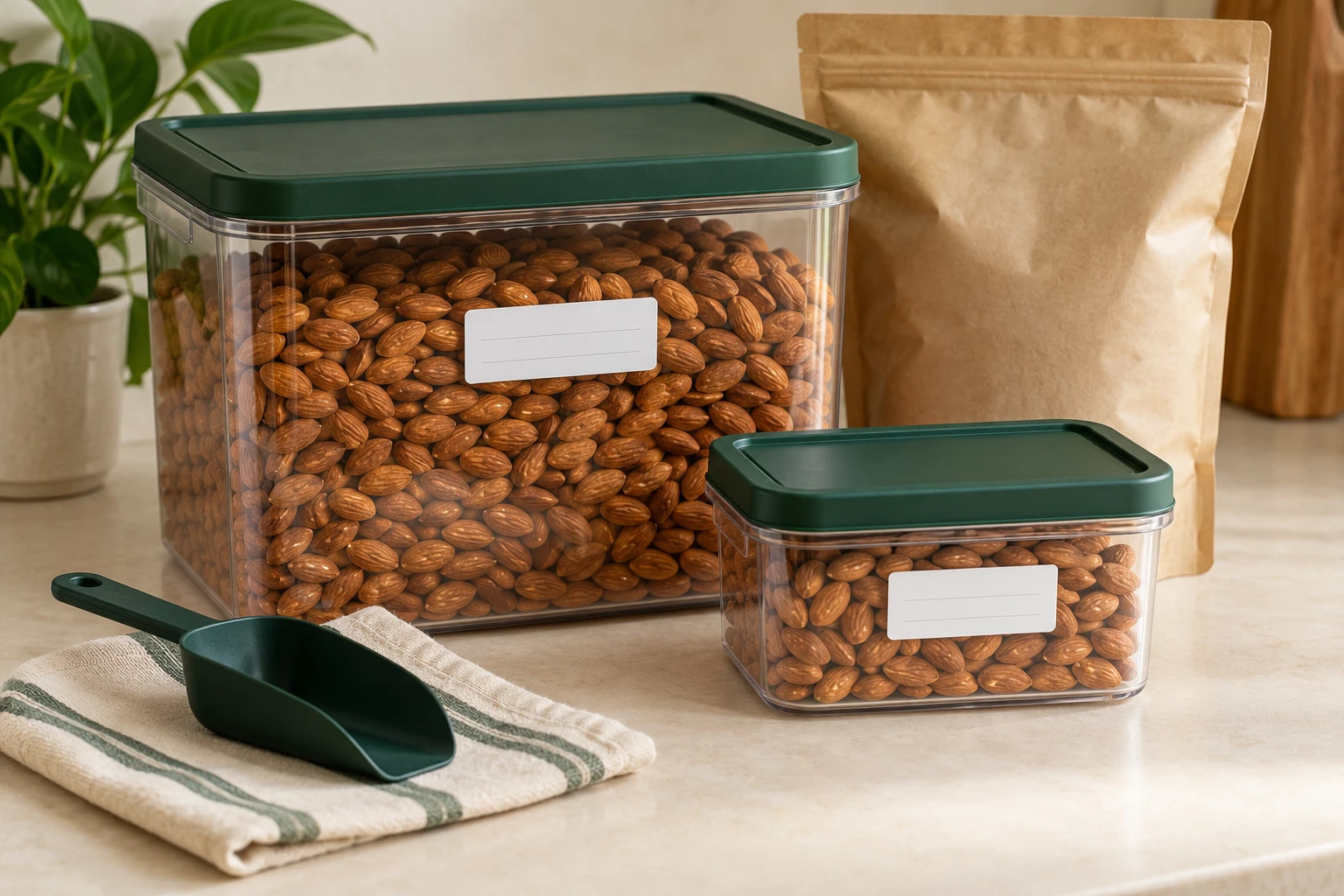
Keep daily portions separate from the bulk supply
Take out a quantity based on actual sales, packing or food preparation. Use clean, dry utensils, then close the bulk pack promptly. Follow the product storage requirements for both the working portion and the remaining pack.
A daily portion still needs the required temperature and moisture protection. Taking out a smaller quantity does not permit all-day room storage. Apply the same storage requirements to unused portions when work ends.
- Close containers of unused food that stayed covered and met the storage requirements.
- Return those containers to the required storage location.
- Keep exposed leftovers separate from the bulk supply.
- If you cannot confirm storage time or temperature, keep the portion out of use.
Do not wash a bulk quantity and return it to dry storage. Washing adds moisture to food intended for dry storage. If a recipe needs washed nuts or seeds, prepare only the quantity needed.
Keep refrigerated packs sealed while the contents warm
Follow the product instructions when taking a pack out of refrigeration. Where those instructions allow warming before use, leave the pack sealed. If the product must stay chilled, keep it under the stated conditions.
Warm, moist air can leave water on cold food after opening. This water is condensation. Keeping the pack sealed limits contact with warm, moist air.
Let the contents warm naturally only where the product instructions allow. Do not apply heat or copy a waiting time from another product. Pack size, starting temperature and room conditions affect the time needed.
Ask the supplier about smaller sealed packs if staff need frequent access. Avoid warming the entire bulk pack to remove a small quantity. Follow the stated time and temperature limits outside refrigeration.
Use opened packs within the stated storage period
Read the printed dates and after-opening instructions together. If no after-opening period is given, ask the supplier how long the product keeps after opening. Ask which storage conditions that period requires.
Read these three items separately:
- Printed dates: Keep the original best-before and expiry/use-by wording.
- Opening date: Record when staff first opened the pack.
- After-opening instructions: Follow any stated time limit and storage conditions.
Best before describes the expected quality period under the stated storage conditions. Do not sell or distribute food after its expiry or use-by date. Moving food into another container does not restart its shelf life. An opening date does not replace the original expiry.
Suppose an earlier delivery expires in December. A later delivery expires in November. Among packs suitable for use, use the November pack first.
Stop using food with mould, insects or unusual smells
Stop using food when you find mould, insects or unusual smells. Set the affected food aside so staff do not sell, pack or use it. Also set aside packs with webbing, unexpected dampness or damaged seals.
Raisins can be naturally chewy, so texture alone cannot confirm spoilage. White material on dates can have different causes. Do not assume it is harmless sugar from appearance alone.
Do not taste suspect food to decide if it is safe.
- Keep the affected food separate from normal use.
- Retain the batch code, original packaging and invoice details.
- Record the problem and photograph any visible signs.
- Contact the supplier and keep the affected batch out of use during review.
A normal smell or appearance does not prove food is safe. Refrigeration alone does not make contaminated food safe. Some harmful substances produced by mould can survive food processing. Do not try to make suspect food safe by roasting, freezing or mixing it.