

What does W240 mean?
W means white whole. A whole kernel keeps the characteristic curved cashew shape; under the AFI definition, no more than one-eighth may be missing. The edible kernel is the part inside the hard shell.
240 is a size designation based on the number of whole kernels in a specified weight. It is not a cashew-tree variety, a flavour grade or an exact count in every retail pack.
W240 count and calculated average weight
AFI specifies W240 at 220–240 whole kernels per pound, or 485–530 per kilogram. Indian CAPEX specifications use 220–240 per 454 g. State the count system in the purchase specification because a commercial pound and 454 g are close, but not mathematically identical.
| Sample weight | Whole-kernel count | What it means |
|---|---|---|
| 100 g | About 48–53 | Convenient estimate, not a grade test |
| 454 g | 220–240 | CAPEX count range |
| 1 kg | 485–530 | AFI trade range |
Calculated average weight per kernel = 454 g ÷ whole-kernel count.
The 220–240 range gives a calculated average of about 1.89–2.06 g per kernel. Individual kernels can be lighter or heavier. Counting a handful cannot confirm the grade of an entire delivery.
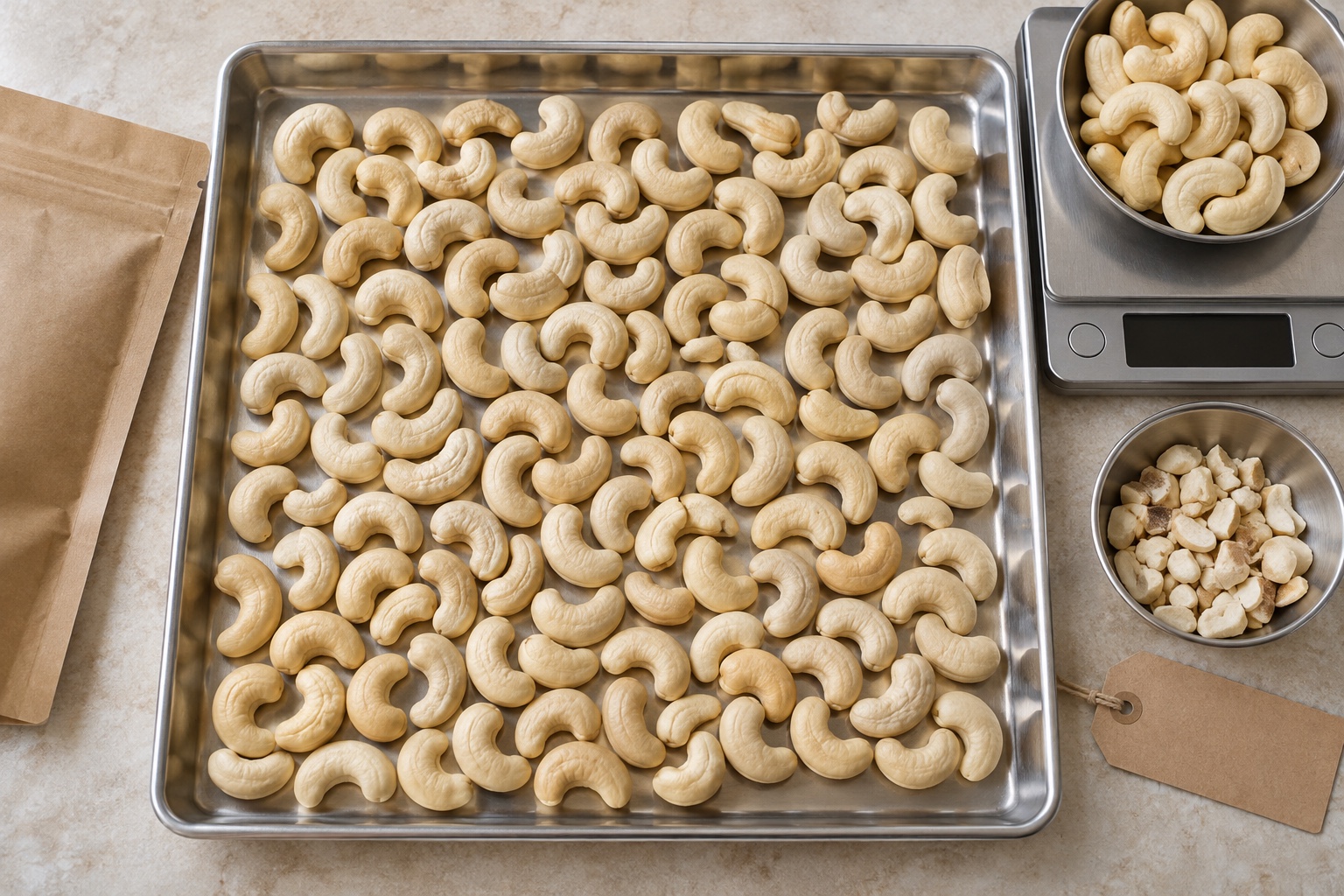
- Match the sample to the delivery batch.
- Weigh 454 g of separated whole kernels.
- Count only kernels that meet the agreed whole definition.
- Weigh broken material separately under the agreed method.
W240 length, width and thickness
In one published study, 50 W240 kernels averaged 24.7 mm long, 15.9 mm wide and 12.28 mm thick at 5% dry-basis moisture. The sample came from a steam-processing unit in Mangaluru, Karnataka.
These dimensions describe that study sample. W240 is assigned by kernel count, not by a fixed millimetre template. Measure the offered batch when a recipe, cavity, topping or pack requires a particular dimension.
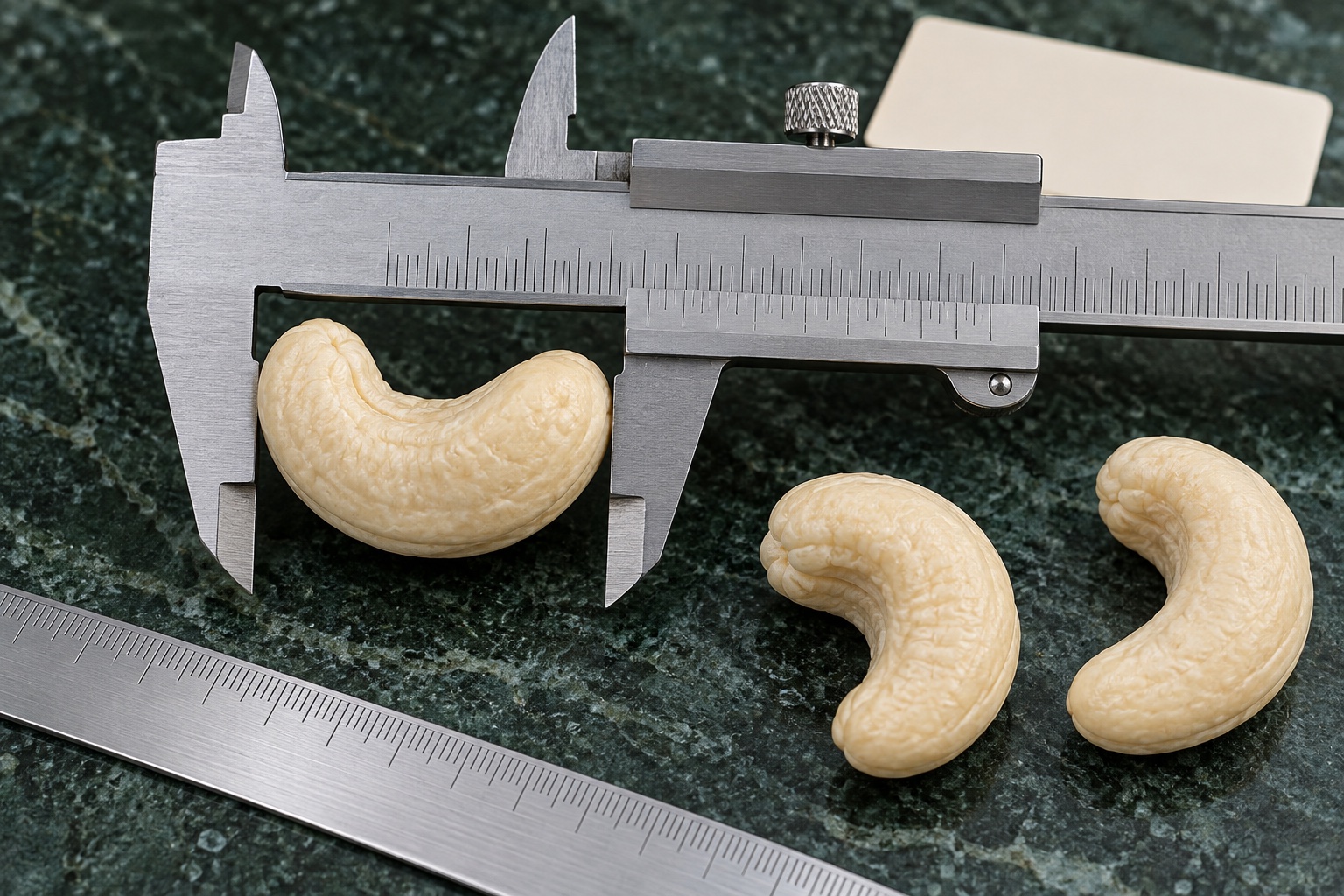
W240 study-sample averages
These are averages from one published study sample at 5% dry-basis moisture. They are not mandatory W240 grade limits.
How W240 compares with W180, W210 and W320
Within the same count system, fewer kernels in the same weight means a larger average kernel. W240 is smaller on average than W180 and W210, and larger on average than W320.
| Grade | Whole kernels per 454 g | Calculated weight per kernel |
|---|---|---|
| W180 | 170–180 | 2.52–2.67 g |
| W210 | 200–210 | 2.16–2.27 g |
| W240 | 220–240 | 1.89–2.06 g |
| W320 | 300–320 | 1.42–1.51 g |
Do not compare only the grade number. Also compare colour, preparation, broken material, usable whole-kernel yield, net weight, packing and delivered cost.
Colour, whole shape and broken material
AFI describes first-quality kernels as white, light yellow or pale ivory. CAPEX also permits light-ash colour in white wholes. The natural seam between the two cotyledons is not a split. Testa is the thin brown skin removed during processing.
Scraping does not automatically make a kernel broken if the characteristic whole shape remains. Splits are lengthwise halves; butts are crosswise breaks; smaller fragments are pieces. They use separate grade codes.
Breakage limits depend on the specification named in the order. CAPEX lists a 5% maximum for W240, while AFI and UNECE allow up to 10% broken kernels by weight in wholes. Never combine limits from different standards.
W240 and SW240
W240 and SW240 can use the same 220–240 count range, but they are different colour grades. SW240 means scorched whole kernels darkened by processing heat. “Scorched” is a grading term; it does not mean a finished roasted snack.
Where W240 cashews come from
W240 identifies a processed kernel grade, not its country of origin. Major raw-cashew producers include Côte d’Ivoire, Cambodia, India and Tanzania. Raw nuts can be grown in one country and shelled, graded or packed in another.
India both grows cashews and imports raw nuts for processing. Producing states include Maharashtra, Karnataka, Kerala, Goa, Andhra Pradesh, Odisha, Tamil Nadu and West Bengal. Processing clusters include Kollam, coastal Karnataka, Panruti, Palasa and Sindhudurg. Ask separately where the crop grew, where it was processed and where it was packed.
Indian varieties such as Vridhachalam-4 and Damodar can produce W240 kernels, but one harvest can contain several kernel sizes. The grade does not identify the variety.
Processing and preparation
Processors heat or steam in-shell cashews, remove the hard shell, dry the kernels, peel off the testa and sort the kernels by colour, size and form. A plain kernel may therefore have received heat during shell removal without being a roasted snack.
W240 can be sold plain, dry-roasted, oil-roasted, salted or flavoured. Confirm preparation, added oil, salt and seasoning separately from the grade code.
Flavour, crunch and nutrition
The W240 code does not grade sweetness, crunch, protein, fat or energy. Roasting method, moisture, storage and seasoning can change flavour and texture. Compare samples prepared in the same way.
Compare nutrition per 100 g, not per kernel. A larger kernel weighs more, so per-kernel comparisons can mislead. Use the label or specification for the exact plain, roasted or seasoned product.
When is W240 useful?
W240 is useful when a clearly visible whole cashew matters but the extra size of W180 or W210 is not necessary. Common uses include premium snack packs, nut mixes, sweets, bakery toppings and gift assortments.
For paste, meal, fillings or recipes that chop the kernel, compare split and piece grades as well. Paying for a whole-kernel grade may not improve the finished product.
How to check a W240 batch sample
Take a representative sample from the same batch that will be supplied. Match the batch code and preparation before testing. Check whole-kernel count, broken material, colour and defects separately.
- Count separated whole kernels in the specified test weight.
- Weigh broken kernels under the method named in the order.
- Record colour, visible defects and any adhering testa.
- Write the sample weight, result, unit, method, date and batch code.
A matching count does not prove origin, freshness, moisture or food safety. Verify those requirements separately.
Moisture, spoilage and allergy
CAPEX lists a maximum 5% moisture for white wholes. Moisture percentage and water activity are different measurements: water activity describes how available the water is for microbial growth. One cannot be converted directly into the other.
Do not taste cashews with mould, live insects, unusual odour or signs of rancidity. Low-moisture foods can still carry harmful bacteria. Cashews can also cause serious allergic reactions; manage allergen labelling and cross-contact under the rules that apply to the business.
Packing and storage
Inspect the inner seal and outer carton at delivery. Record punctures, failed seals, dampness, pests or crushed cartons before storage. A total pack weight includes packaging, so compare the declared net weight after allowing for the container.
Keep sealed packs away from heat, moisture, pests and strong odours. After opening, reseal the pack or use a clean, dry food-grade container. Keep the original batch code, packing date and best-before information with the product.
What to write in a W240 purchase specification
- W240 and the grading standard or count system.
- Required colour grade: W240, SW240 or another stated grade.
- Plain, roasted, salted or flavoured preparation.
- Maximum broken material and other quality limits.
- Net weight, pack size, inner seal and outer carton.
- Origin, crop year or processing location when required.
- Representative sample, batch code and documents to be supplied.
Approve the written specification and the offered batch sample before confirming a wholesale order.