

What is a cashew grade?
A cashew grade groups kernels by size, colour and shape. The kernel is the edible cashew inside the shell. Cashews can be whole, split lengthwise, broken crosswise or in smaller pieces. Kaju grades identify these differences through names and codes.
A specification is the written product description, including its limits. Count ranges, piece sizes and allowed breakage belong in that description. IS 7750:2013 is an Indian standard for cashew kernels.
How to read W320 and SW320
W320 identifies white whole cashews in the 320 size. SW320 identifies whole cashews darkened by heat during processing. The trade name for this category is scorched wholes. Both share the 320 size number but belong to different colour grades.
W320 does not promise exactly 320 kernels per 454 g. Check the count limit or range attached to the grade. For a quote using WW320, confirm the colour, count range and breakage limit.
Grade codes do not identify a brand, tree variety or growing country. State origin separately if you need cashews from a particular country. Plain, roasted, salted and flavoured also need separate descriptions.
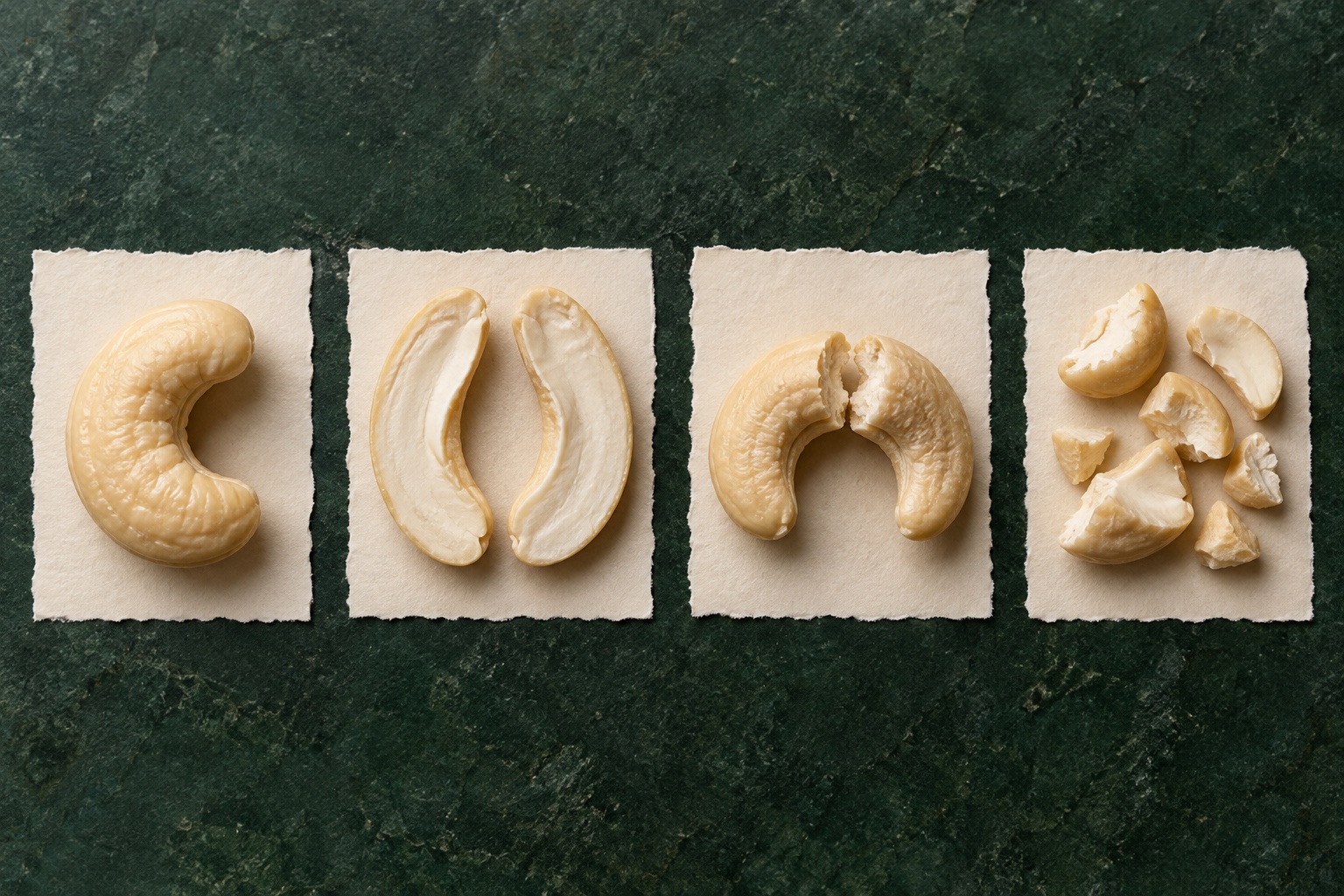
Kernel form and kernel size are separate parts of a grade.
Whole cashew size chart and kernels per kg
Fewer whole cashews in the same weight indicate larger average kernels. W180 kernels are larger on average than W320 kernels. The size number relates to a count per pound, approximately 454 g.
In this chart, pieces per kg refers to individual whole cashews. Compare sizes using the CAPEX white-whole ranges below. The per-kg counts and average weights are rounded calculations, not separate grade limits.
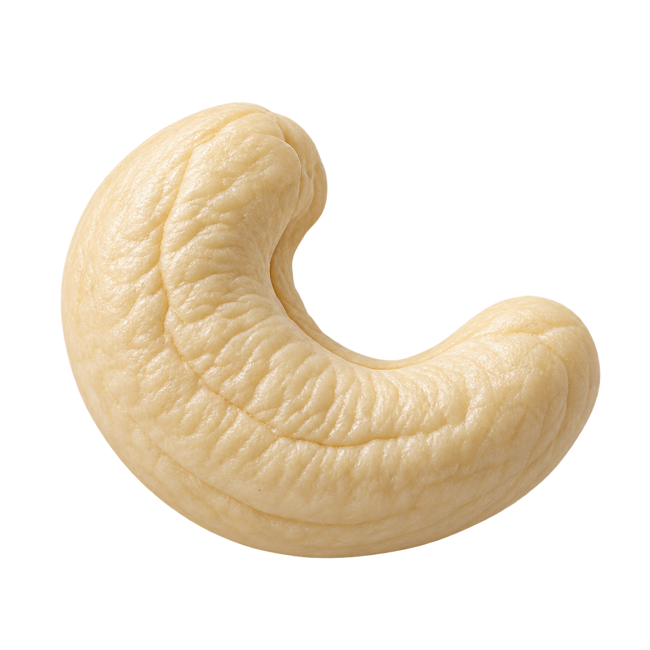 W18026.3 mmW21026.1 mmW24024.7 mmW32022.5 mm
| Grade | Kernels per 454 g | Approximate kernels per kg | Calculated average kernel weight (g) |
|---|---|---|---|
| W180 | 170–180 | 374–396 | 2.52–2.67 |
| W210 | 200–210 | 441–463 | 2.16–2.27 |
| W240 | 220–240 | 485–529 | 1.89–2.06 |
| W320 | 300–320 | 661–705 | 1.42–1.51 |
| W450 | 400–450 | 881–991 | 1.01–1.14 |
| W500 | 450–500 | 991–1,101 | 0.91–1.01 |
Kernels per kg = kernels per 454 g × 1,000 ÷ 454.
For W320, 300–320 kernels per 454 g converts to approximately 661–705 per kg. A count range stated directly per kg may differ from this rounded conversion. Use the count range written on your order.
To find average kernel weight, divide the weight of whole kernels by their number. If 1 kg contains 700 whole kernels, each averages about 1.43 g. Use the measured count in this calculation, rather than the grade number.
W150, W280 and W400
Under the 2023 UNECE size limits, size 150 has a maximum of 150 kernels per pound. W180 is not the largest whole-size designation.
W280 and W400 appear in the 1999 UNECE size table. Their count limits need the relevant grading reference. Ask for the written range when a quote uses either code.
Why grade charts show different counts
Some charts give maximum counts; others give count ranges. Under UNECE 2023, size 320 has a maximum of 320 kernels per pound. The CAPEX white-whole range is 300–320 per 454 g.
A maximum sets the upper count without giving a minimum. Do not add an assumed lower count to a maximum-only table. Match the weight unit, grading standard and edition before comparing counts.
Cashew length, width and thickness
The same W grade can include kernels of different lengths and thicknesses. Use the average measurements below as examples, rather than fixed grade limits. The sample averages apply at 5% dry-basis moisture: 5 g of water per 100 g of dry material.
| Grade | Average length (mm) | Average width (mm) | Average thickness (mm) |
|---|---|---|---|
| W180 | 26.3 | 18.1 | 13.3 |
| W210 | 26.1 | 17.4 | 12.7 |
| W320 | 22.5 | 14.1 | 11.2 |
| W450 | 20.6 | 13.3 | 9.8 |
Measure the sample if your product needs a particular thickness. Write any required millimetre dimensions separately from the count grade.
Cashew grades by colour
Colour grades separate lighter kernels from kernels with more darkening or marks. Whole cashews and broken pieces can belong to each colour category. A colour grade cannot confirm freshness or food safety.
White whole cashews
White whole cashews can be white, pale ivory or light ash in colour. Pale ivory is a cream shade; light ash is a pale grey shade.
Whole cashews darkened by heat (SW)
SW identifies whole cashews darkened by processing heat. The trade name is scorched wholes. SW alone does not tell you if the cashews are salted or flavoured.
SW sizes include SW180, SW210, SW240, SW320, SW450 and SW500. SW without a number does not give a kernel count. Ask for the count range when a quote only says SW.
Darker whole cashews (SSW and DW)
SSW and SW IA identify whole cashews with more darkening or surface marks. The trade name is scorched wholes seconds. DW identifies dessert whole cashews. Dessert is a grade name; it does not indicate added sugar.
SSW can include darker, shrunken or spotted kernels. DW can include deeper brown colouring and surface marks.
Splits, butts and broken cashew grades
Splits separate lengthwise into the two long halves of a kernel. A butt has a crosswise break, with the long halves still attached. LWP, SWP and BB identify categories of smaller pieces.
Broken cashew grade codes
Use these code names when reading a quote.
| Code | Trade name | What it describes |
|---|---|---|
| B | Butts | Crosswise breaks, with the long halves still attached |
| S | Splits | Lengthwise halves |
| LWP | Large white pieces | Larger pieces in the white colour category |
| SWP | Small white pieces | Smaller pieces in the white colour category |
| BB | Baby bits | Very small pieces |
| SB | Scorched butts | Crosswise breaks darkened by processing heat |
| SS | Scorched splits | Lengthwise halves darkened by processing heat |
| SP | Scorched pieces | Pieces darkened by processing heat |
| SSP | Scorched small pieces | Smaller pieces darkened by processing heat |
| SPS | Scorched pieces seconds | Pieces with more darkening or surface marks |
| DP | Dessert pieces | Pieces with deeper colour or surface marks |
| DSP | Dessert small pieces | Smaller pieces with deeper colour or marks |
| DB | Dessert butts | Crosswise breaks with deeper colour or marks |
| DS | Dessert splits | Lengthwise halves with deeper colour or marks |
There is no single fixed grade total across all grading systems. Totals change when a chart includes numbered sizes and alternative names separately.
How broken cashew pieces are sized
A sieve is a screen with measured openings used to sort pieces. Material retained on a screen stays on it instead of passing through. The CAPEX piece sizes use these minimum openings: LWP 4.75 mm, SWP 2.80 mm and BB 1.70 mm.
Check how much smaller material the grade allows. A sieve opening does not give every fragment an identical thickness. Shape affects how a piece passes through the opening.
For AFI large pieces, sizing uses screens with 8.00 mm and 6.30 mm square openings. At least 95% by weight must be large enough to remain on the 6.30 mm screen. No more than 50% by weight can remain on the 8.00 mm screen unless the buyer approves an exception. Match the screen openings and allowed smaller pieces before comparing offers.
JH, JK and other Indian trade names
JH, JJH, JK and tukda are trade labels, not complete size specifications. The label alone does not give the count, sieve size or colour. Confirm the product behind the label before matching prices.
JH and JJH can identify jumbo halves, depending on the seller. Confirm if JH and S describe the same product in the quote. Check the size and colour of the offered halves.
For JK, confirm the shape, sieve size and colour. Tukda is a trade term for broken kaju. It does not identify one fixed piece size.
How to check a cashew sample
Compare the sample with the agreed grade. Whole-kernel count, broken percentage and food defects require separate checks. Take portions across the batch under the agreed sampling method, instead of picking the best-looking kernels.
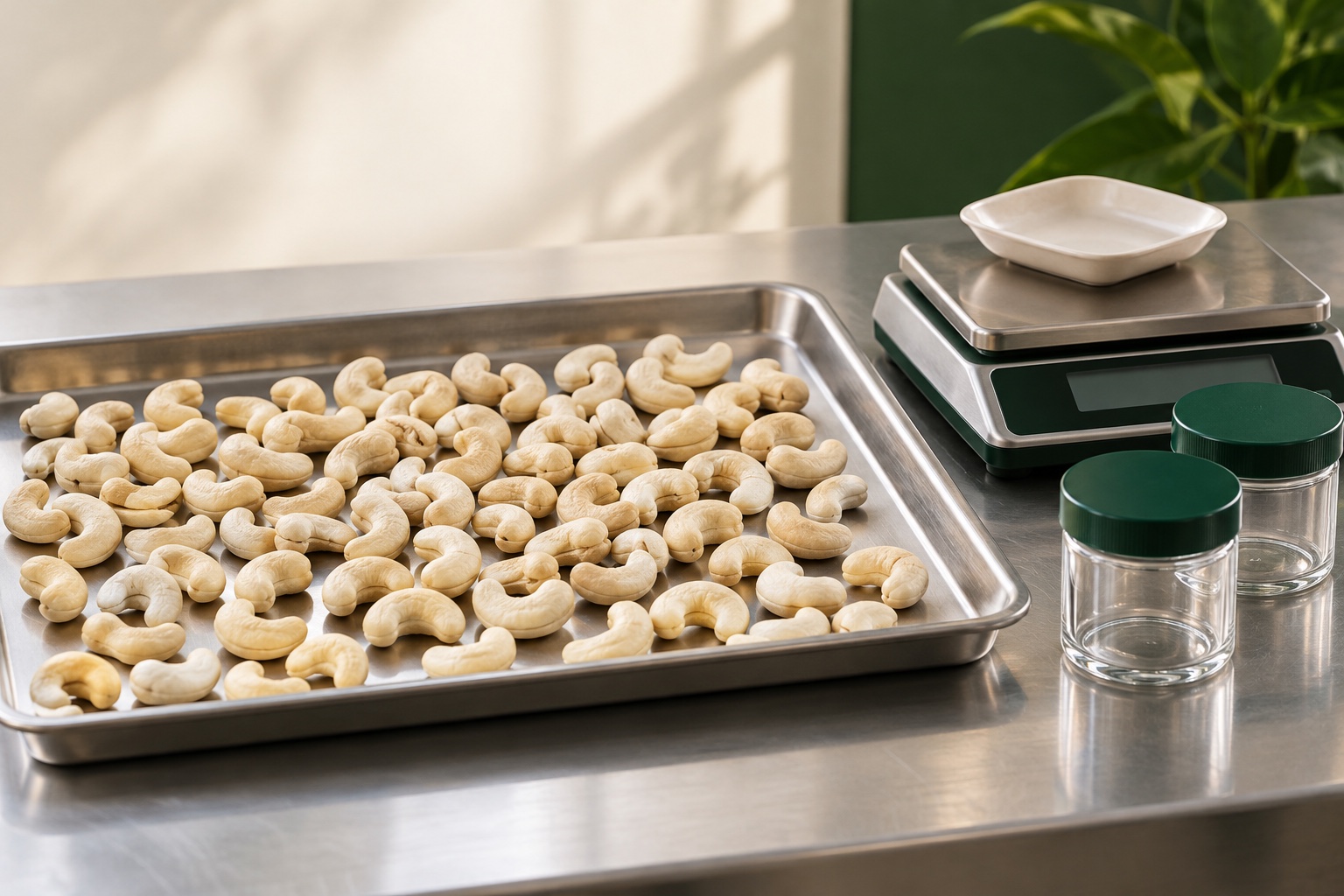
- Match the delivery batch code.
- Count whole kernels in the specified weight.
- Weigh broken pieces separately.
- Record colour, defects and the method used.
Weigh and count whole cashews
Choose the sample weight from the grading method agreed for the order. A composite sample combines portions from different parts of the batch. Place the empty container on the scale and reset it to zero before adding kernels.
Separate the whole kernels, then weigh 454 g for an AFI count test. Count those kernels and record the weight and count together. Do not count only the visible wholes in a mixed 454 g sample.
AFI checks breakage in 1,000 g and defects in 500 g. Use those sample weights when AFI applies to the order.
Approximate kernels per kg = whole-kernel count ÷ whole-kernel sample weight in g × 1,000.
Calculate the percentage of broken cashews
Broken percentage = weight of broken pieces ÷ total sample weight × 100.
50 g of broken pieces in a 1,000 g sample is 5% by weight. Compare the result with the maximum breakage allowed on the order. Use the total sample weight before removing the broken pieces.
A small chip can still fall within a whole-kernel definition. Under AFI, a kernel can qualify as whole with up to one-eighth missing. A whole-grade batch can also contain an allowed amount of separate broken material.
Tolerance is the amount of size, colour or breakage variation allowed. CAPEX white wholes allow up to 5% broken material; AFI whole grades allow up to 10% by weight. Use weight to calculate breakage. Check size variation separately, because a whole-size rule may use kernel count.
Check colour and signs of spoilage
Check colour under the lighting required by the agreed method. Look for mould, pests, unexpected dampness and unusual smells. Stop using suspect food and keep it away from the usable batch.
Do not taste food to test for spoilage. Do not assume an unfamiliar dark mark is allowed by the grade. Dessert grades still need to meet food-safety requirements.
A visual check cannot measure moisture or rule out every contaminant. Request the applicable test results when the order requires laboratory checks. Keep those results linked to the batch you receive.
Choosing a cashew grade
Choose whole kernels or pieces to suit the finished product. For whole-kernel packs, compare size and broken material in equal net weights. A photograph alone cannot show the count per kilogram.
For one-cashew toppings, use the measured kernel count. If a kilogram contains 700 usable wholes, it supplies 700 one-cashew toppings. Estimate cashew cost per topping by dividing price per kg by usable whole kernels per kg.
For grinding, compare equal cashew weights in the same recipe. Compare the colour and smoothness of the finished paste. Keep the preparation and other recipe quantities the same during the comparison.
Write the full grade on the order
Write the size, colour and breakage limit on the order. State whole kernels, splits, butts or pieces, followed by colour. Add count limits or sieve openings and the net weight.
An order can read “white whole W320, 300–320 kernels per 454 g.” Add the agreed breakage limit, pack weight and packing type. Name the grading standard and edition when the order uses one.
State plain, roasted, salted or flavoured separately. Record the growing country if the order requires an origin. Keep the agreed sample reference and test results with the order.
Use the same product details on the quote and order. Compare the delivery with those agreed details.