

Cashew nuts are called kaju in Hindi, Marathi, Gujarati and Punjabi. In Tamil, the name is mundiri paruppu; in Telugu, jeedi pappu. Kannada speakers use geru beeja, while kasu andi is a Malayalam name. Other names include hijli badam in Bengali and kaju badam in Assamese.
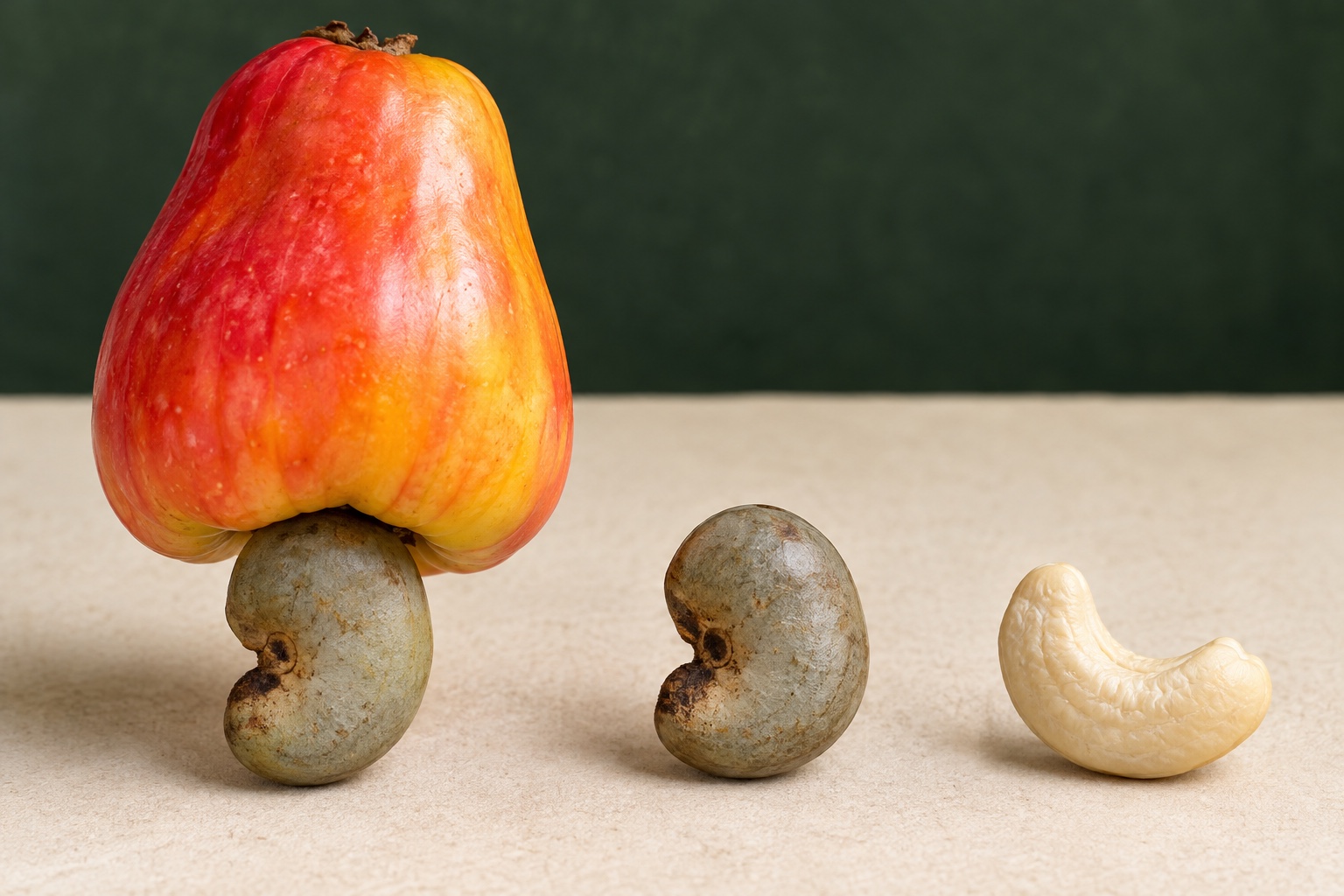
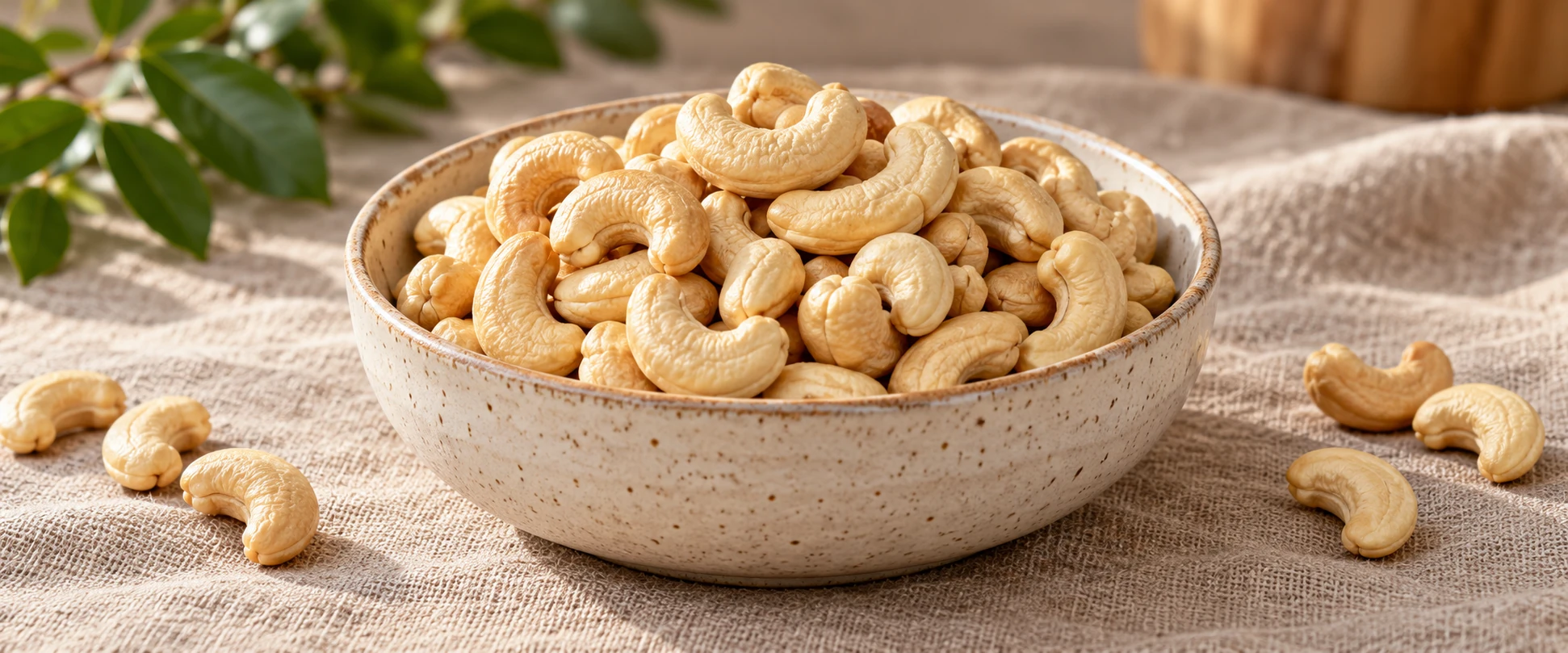
Cashew origin and history in India
Cashew is native to tropical America, including Brazil. Portuguese traders introduced cashew to India through Goa during the 16th century. Cultivation later spread to other Indian regions. The English word cashew comes from Portuguese, with roots in the Tupi-Guarani names acajú and cajú.
Cashew processing in Kerala expanded during the 1920s and 1930s. Kollam became a centre for processing and export trade. Local businesses opened plants to roast and shell nuts for export. Women formed a large part of the workforce in shelling, peeling and grading. Factories also began processing imported in-shell nuts.
Where India grows and processes cashews
India grows cashews along its western and eastern coasts. Cashew-growing states include Maharashtra, Karnataka, Kerala, Goa, Andhra Pradesh, Odisha, Tamil Nadu and West Bengal. Smaller growing areas include Chhattisgarh and parts of northeastern India.
Indian processors use both locally grown and imported in-shell nuts. An Indian factory address does not prove that the cashews grew in India. Ask for the growing country and processing location. Packing may happen at another location.
Goa Cashew (Kaju Or Caju) is a registered geographical indication, or GI. Its registration certificate is dated 3 October 2023. A GI identifies a product linked to a particular place. The registered area is Goa. A Goa business address alone does not establish eligibility to use the GI name.
Cashew processing
Cashew processing separates the edible kernel from the shell and thin skin. The processing sequence includes these stages:
- Conditioning: Conditioning uses moisture or heat to prepare the shell for removal. Steam treatment supplies both heat and moisture.
- Shelling: Machines or workers cut or crack the shell. The thin skin remains around the kernel after shelling.
- Drying: Processors dry the kernels to make the thin skin easier to remove.
- Peeling: Processors remove that skin, called the testa.
- Grading: Processors sort kernels by size, form, colour and defects.
- Packing: Processors seal the graded kernels for storage and transport.
Shelling and peeling can break kernels, reducing the share sold as wholes. Raw has 2 meanings in the cashew trade: in-shell nuts and unroasted edible kernels. Peeled kernels sold as raw have undergone shelling, drying and peeling. Kernels sold as raw may have undergone heat treatment during processing.
Snack roasting heats shelled kernels to develop flavour and colour. This differs from heat treatment before shelling.
The shell contains cashew nut shell liquid, or CNSL. This liquid can burn or irritate skin. Edible cashew oil comes from the kernel. Shell liquid has industrial uses. Do not use shell liquid as cooking oil.
Whole cashews, splits and pieces
Broken cashews, also sold as broken kaju, include splits, butts and pieces.
- Whole kernels: Cashews that retain their curved shape.
- Splits, or split kaju: Kernels separated lengthwise into halves.
- Butts: Kernels broken across the width, with the 2 lengthwise halves still joined.
A whole grade can include slightly chipped kernels. The Association of Food Industries (AFI) adopted its cashew kernel specifications in September 2023. These rules allow up to one-eighth of a kernel to be missing from a whole. A whole-kernel batch can also contain up to 10% broken kernels or pieces by weight under those rules. These U.S. trade specifications do not set Indian legal limits.
For smaller pieces, grading uses test sieves: screens with holes of a stated size. The CAPEX product specifications list these piece sizes:
- Large white pieces (LWP): Broken white kernels that do not pass through a 4.75 mm sieve.
- Small white pieces (SWP): Smaller than LWP, but do not pass through a 2.80 mm sieve.
- Baby bits (BB): Smaller than SWP, but do not pass through a 1.70 mm sieve.
Sieve openings describe the sizing method, not a fixed thickness for each piece. Ask which grading rules apply when comparing piece grades. Broken kernels are not the same as spoiled kernels. Check for spoilage and damage as well as kernel shape.
Cashew grades and sizes
Cashew grades describe size, colour and kernel form. A grade code is not the name of a plant variety. Size codes do not measure freshness, food safety or nutrient content.
Cashew pieces per kg and weight per kernel
W320 has approximately 661–705 whole kernels per kg under the chart used below. The calculated average weight is about 1.42–1.51 g per kernel. W180 has fewer kernels in the same weight because its kernels are larger on average.
The CAPEX grading specifications use W for white whole cashews. The number refers to kernel count per pound, approximately 454 g. The kilogram counts below are calculated from the published 454 g ranges.
| Grade | Published kernels per 454 g | Approximate kernels per 1 kg | Calculated average weight per kernel (g) |
|---|---|---|---|
| W180 | 170–180 | 374–396 | 2.52–2.67 |
| W210 | 200–210 | 441–463 | 2.16–2.27 |
| W240 | 220–240 | 485–529 | 1.89–2.06 |
| W320 | 300–320 | 661–705 | 1.42–1.51 |
| W450 | 400–450 | 881–991 | 1.01–1.14 |
| W500 | 450–500 | 991–1,101 | 0.91–1.01 |
Kilogram counts are approximate conversions, rounded to the nearest whole kernel. Average weights use the unrounded calculations. These conversions do not replace the agreed grading specification or guarantee the weight of each kernel.
To calculate kernels per kg: multiply the count per 454 g by 1,000, then divide by 454.
To calculate average kernel weight: divide 1,000 g by the number of kernels in 1 kg.
For a batch with 680 kernels per kg, 1,000 ÷ 680 gives approximately 1.47 g per kernel. A topping of 1 kernel on each of 100 sweets would use approximately 147 g. Weigh several kernels from your batch to estimate the topping weight.
Fewer kernels in the same weight indicate larger kernels on average. Count ranges can also differ between specifications. For example, the AFI specifications use 140–180 kernels per pound for size 180, rather than 170–180. Compare the specified count range, not the grade number alone.
Cashew length, width and thickness
A cashew grade number does not specify fixed length, width or thickness. Two batches can meet the same count range without having identical dimensions. Measurements from a sample help show the physical differences.
A 2015 study by ICAR–Directorate of Cashew Research reported these average dimensions for processed kernels:
| Grade | Length (mm) | Width (mm) | Thickness (mm) |
|---|---|---|---|
| W180 | 26.3 | 18.1 | 13.3 |
| W210 | 26.1 | 17.4 | 12.7 |
| W320 | 22.5 | 14.1 | 11.2 |
| W450 | 20.6 | 13.3 | 9.8 |
These figures describe the study samples at 5% moisture on a dry-weight basis. That moisture measure compares water weight with dry kernel weight. The dimensions are sample averages, not mandatory limits for those grades.
In these samples, W180 and W210 had similar lengths but different widths and thicknesses. The figures do not establish dimensions for W240 or W500. Check a batch sample instead of assigning measurements from its grade number.
White, scorched and dessert grades
White grades include white and pale ivory kernels. Scorched grades include kernels darkened by heat during processing. Under AFI rules, dessert blemished wholes can include shrivelled kernels and dark surface markings.
Dessert is a grade term, not a sweetened product. Scorched describes a grade; roasted describes a preparation method. These grade terms do not replace checks for mould or rancidity.
Words such as jumbo and premium do not identify a complete grade. Compare size, colour class, kernel form and allowed defects. Breakage limits can differ too: CAPEX specifications allow 5% broken kernels in white wholes, while AFI allows 10% by weight.
Raw, roasted, salted and flavoured cashews
Raw and roasted describe preparation; salted and flavoured describe additions. A roasted cashew can also be salted or flavoured. Dry roasting uses heat without added roasting oil. Oil roasting cooks cashews with added oil.
Flavoured cashews can contain seasoning, oil, salt, sugar or coatings. The word roasted does not tell you what else was added. Read the ingredient list and confirm the preparation method. For plain kernels, check the ingredient list for added oil or seasoning.
Food uses of cashews
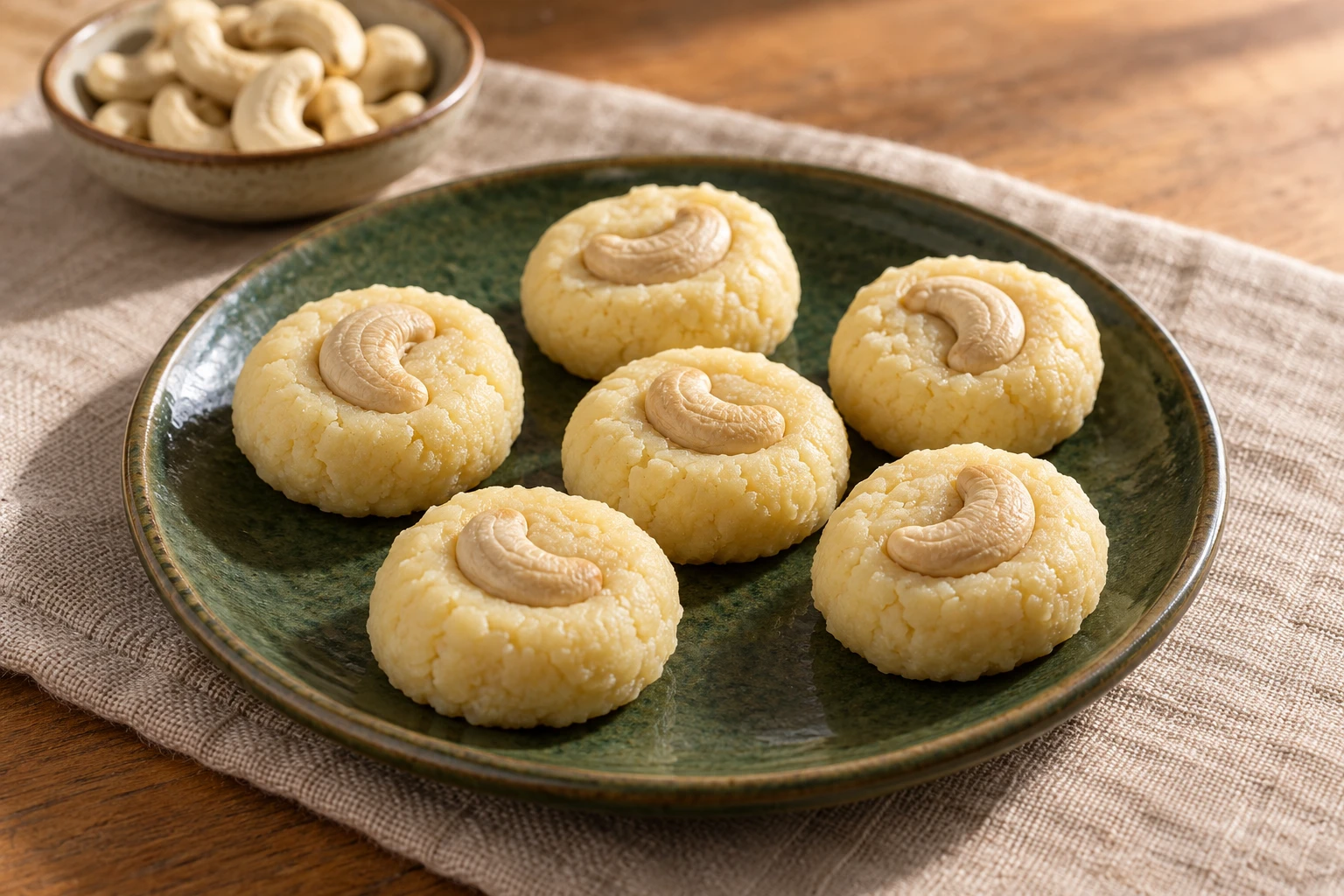
Whole cashews go into snacks, garnishes and sweets. Bakers use chopped cashews in cakes, biscuits and fillings. Ground kernels form the base of kaju katli and thicken sauces and gravies. For ground cashew recipes, compare piece grades as well as wholes.
Cashew apples go into juice, preserves and alcoholic drinks. Goan cashew feni uses the apple, while kernel-based cashew drinks use the seed.
Cashew powder, paste, butter and drinks
Pure cashew powder consists of finely ground cashew kernels. Check packaged cashew powder for added sugar or other ingredients. For smooth pastes, check how finely the powder is ground.
Cashew paste contains ground kernels and may include water or other additions. Adding water reduces the amount of cashew in each 100 g of finished paste. Paste containing water may need refrigeration and earlier use after opening. Follow the paste label rather than storage instructions for dry kernels.
Cashew butter is a spread made by grinding cashews. Some products contain only cashews; others include oil, salt or sugar. Check the ingredient list to identify these additions.
Cashew drinks contain water and cashews, with recipes varying by product. Use the finished-product nutrition label rather than whole-kernel figures.
Cashew nutrition and health
Cashew nutrition per 100 g and 30 g
These cashew nutrition values come from the Indian Food Composition Tables 2017. The 30 g column shows the calculated amounts in a smaller portion.
| Nutrient | Per 100 g | Per 30 g |
|---|---|---|
| Energy (kcal) | 583 | 175 |
| Protein (g) | 18.8 | 5.6 |
| Total fat (g) | 45.2 | 13.6 |
| Saturated fat (g) | 7.8 | 2.3 |
| Available carbohydrate (g) | 25.5 | 7.6 |
| Dietary fibre (g) | 3.9 | 1.2 |
| Magnesium (mg) | 307 | 92 |
| Iron (mg) | 6.0 | 1.8 |
| Zinc (mg) | 5.3 | 1.6 |
| Copper (mg) | 2.23 | 0.67 |
Values are rounded from cashew entry H005. The 30 g figures are calculated from the same entry. Energy is converted from kilojoules to kilocalories. Available carbohydrate excludes dietary fibre.
The 30 g amount is a comparison, not a fixed daily recommendation. A fixed number of cashews weighs differently across size grades. Weigh cashews before calculating nutrients per portion.
Nutrition in raw, roasted and salted cashews
Added salt increases sodium content. USDA reference entries report these sodium values per 100 g:
- Raw cashews: 12 mg.
- Dry-roasted cashews without added salt: 16 mg.
- Dry-roasted cashews with added salt: 640 mg.
These USDA figures describe specific reference foods, not every cashew product. The sodium in a commercial product depends on its recipe. Read the label for the cashews you buy or serve.
Added oil can increase fat and calories; sweet coatings add sugar. Water content also affects nutrition figures per 100 g. Foods with less water contain more dry material in the same weight. Differences between reference foods do not measure the effect of roasting alone.
Cashews, blood pressure and cholesterol
Cashew trials have reported different results for blood pressure and cholesterol. A 2018 trial followed 300 Indian adults with type 2 diabetes for 12 weeks. Both groups received dietary advice, and 1 group also ate 30 g of cashews daily.
Compared with the advice-only group, the cashew group had a greater fall in systolic blood pressure. Systolic pressure is the upper number in a blood pressure reading. HDL, a type of blood cholesterol, also increased more in the cashew group. Changes in weight and blood sugar did not differ significantly between groups.
A 2019 trial involved 42 adults eating 42 g of cashews daily for 4 weeks. Other foods were reduced to keep total calories equal between the diets. The trial found no statistically significant differences in blood fats, blood pressure or blood sugar. The study did not establish a difference between the diets for these results.
The trials involved different participants, diets and study periods. These results do not prove that cashews prevent or treat disease.
Cashew allergy and cross-contact
Cashew allergy can cause severe reactions. Symptoms can include swelling, vomiting and hives. Hives are raised, itchy patches on the skin. Breathing difficulty, throat swelling or collapse requires urgent medical help.
Food labels group cashews with tree nuts, even though the edible kernel is a seed. Roasted cashews can still cause a reaction in someone with cashew allergy.
Cross-contact happens when cashew proteins enter another food by accident. Proteins can transfer through shared utensils, surfaces and production equipment. Shared cooking oil can transfer cashew protein into foods cooked afterward. Food can contain cashew protein without visible cashew pieces.
When buying or preparing food for someone with cashew allergy:
- Read the ingredient list and allergen declaration.
- Ask about shared equipment and cooking oil.
- Request allergen information for the specific product and production process.
- Use separate utensils and containers alongside other measures that prevent cross-contact.
Separate equipment alone does not establish that food is safe. Cleaning, storage and staff practices also need to prevent protein transfer.
Cashew quality and freshness
Colour, surface marks and remaining skin
Kernel colour forms part of grading but cannot confirm freshness. Thin brown patches may be traces of testa left after peeling. Scraping during processing can also leave surface marks.
Rancidity, mould and insect damage
Rancidity develops as the kernel oils break down and can cause an unusual smell. Stop using food with mould, insects, webbing or insect residue. Separate affected packs and record the batch number.
Do not taste affected cashews to check if the food is safe.
Appearance and smell cannot rule out every hazard. Laboratory tests are needed to check for hazards such as aflatoxins and Salmonella. Contact the supplier with the batch number, pack details and photographs.
Crop year, processing date and packing date
Crop year records the harvest year or season. A packing date records when the kernels entered the pack. Ask which processing stage the processing date records.
A recent packing date does not confirm a recent harvest. Ask for the crop year to compare when the nuts were harvested.
Batch numbers and laboratory tests
The batch number connects a pack with production and distribution records. Match the pack batch number with the batch identified on the report. Read the sample date, tests performed and reported results.
Laboratory tests check moisture, oil changes and food-safety hazards:
- Moisture testing measures water in the sample.
- Peroxide value testing helps assess early oxidation in the oils. Oxidation involves oxygen and can contribute to rancidity.
- Aflatoxin testing checks for toxins made by certain moulds.
- Salmonella testing checks for a bacterium that can cause illness from contaminated food.
Low moisture content can make kernels break more easily. Excess moisture can make kernels clump. Lower moisture is therefore not automatically better.
A laboratory report covers the submitted sample and the tests listed. Compare results with the agreed specification and applicable food-safety requirements.
Why cashew prices differ
Cashew prices depend on grade, processing and sale terms. Processing costs include labour, energy, sorting and packing. Roasting and seasoning add processing costs and the cost of oil, salt or coatings.
A W180 quote and an LWP quote cover different kernel forms. Compare piece grades separately from whole-kernel grades. For 2 quotes using the same grade code, compare allowed breakage and colour defects.
Order quantity, pack size and delivery terms can change the total cost. Compare equal net weights and check which packing, freight and tax charges are included.
Cashew packaging
Cashew packaging limits moisture entry, air exposure and handling damage. The inner pack seals the kernels against outside air and moisture. The outer carton protects the inner pack during transport. Inspect both when a delivery arrives.
Vacuum packing and gas flushing
Vacuum packing removes air before sealing. Nitrogen flushing replaces much of the air with nitrogen. Some gas-packing methods use a mixture of carbon dioxide and nitrogen.
Opening or damaging the pack can let air and moisture enter. Kernel freshness before packing, remaining oxygen and storage temperature affect shelf life.
Packaging for transport
The outer carton protects against pressure and handling damage. Report a torn inner pack even when the carton is intact. Look for punctures, failed seals, dampness and crushed cartons.
Protect packs from water and sharp objects during handling. Keep the original label attached so batch numbers and dates remain available.
Cashew storage and shelf life
Cashew shelf life depends on kernel form, preparation, packaging and storage conditions. Cutting and grinding expose more kernel surface to air. Heat, moisture and air exposure can shorten shelf life.
Plain kernels and water-containing pastes need different storage conditions. Use the instructions for the specific product and pack.
Storage before and after opening
Protect unopened packs from heat, moisture, pests and strong smells. Humidity is moisture in the air. Keep the storage area within the temperature and humidity limits supplied for the product.
After opening, reseal the pack or transfer the kernels into a clean, dry container. Use a container made for storing food. Use clean, dry utensils and close the container after removing each portion.
Keep the original batch number and date markings. Record the opening date separately. Keeping different batches in separate containers helps you trace kernels to their original packs.
Refrigeration and freezing
Refrigerating nuts can slow rancidity. Use cold storage that meets the stated temperature limits. For longer storage, freeze plain kernels only when the product instructions and packaging allow it.
Follow the stated temperature limits and keep the kernels sealed. A sealed pack helps protect against moisture and smells from other foods.
Cold kernels can collect condensation in warm, humid air. Condensation is water that forms on a cold surface. For dry kernels, keep the pack sealed while it warms naturally before opening. Follow the supplied opening instructions.
Do not use a heater to warm the pack. Pastes or drinks containing water may need continuous refrigeration. Follow the paste or drink label, including refrigeration instructions after opening.
Best-before and expiry dates
A best-before date concerns quality under the stated storage conditions. After an expiry or use-by date, food may no longer remain safe. Do not sell or distribute food after its expiry or use-by date.
Damage or poor storage can make food unsafe before the printed date. Reject spoiled food even if the printed date has not passed. Follow any shorter period stated for use after opening.
Refrigerating or repacking food does not automatically extend the original date. Keep the storage instructions with the pack or on the container label.