
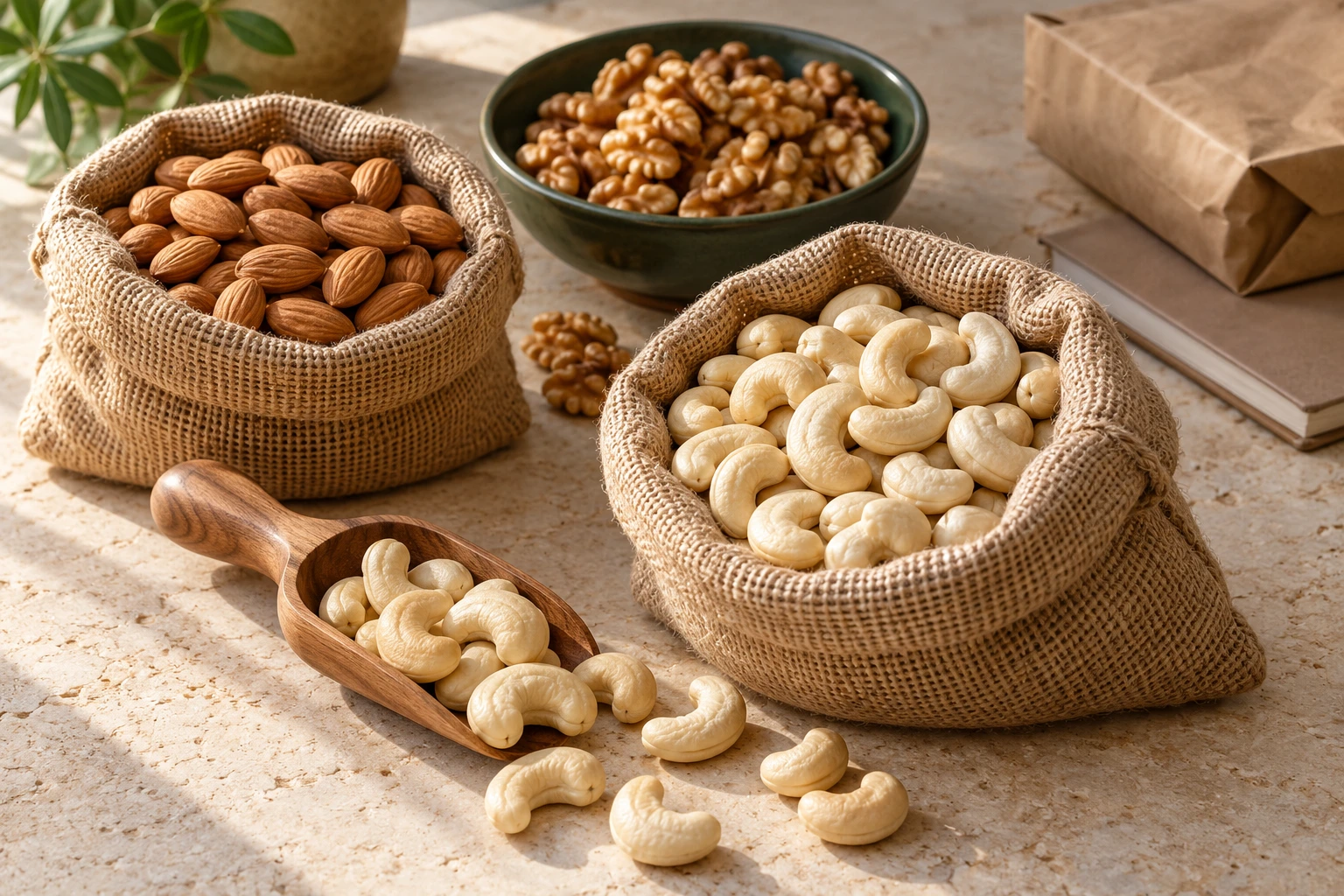
Make sure both quotes cover the same product
A price for cashews needs more detail than the product name. The quote should state the grade, size and whole nuts or pieces. A kernel is the part inside the nut shell. Grade rules can cover size, colour and the amount of broken or damaged nuts.
| Product | Details you need before comparing prices |
|---|---|
| Cashews | Grade, size, whole kernels or pieces, and the allowed percentage of broken pieces |
| Almonds | Variety, size, quality grade, and whole nuts or cut pieces |
| Walnuts | With or without shells; halves or pieces; colour |
| Dates | Variety, size, and whole or pitted dates (stones removed) |
| Raisins | Variety, size, with or without seeds, and any added oil |
| Seeds | Seed type, whole or hulled (outer covering removed), raw or roasted, and seasoning |
Roasting, salt and added oil also belong in the product description. If a supplier offers another grade, check the change before accepting the price. Keep separate prices for the original product and the alternative.
Know which grade the price covers
White whole cashews carry size grades such as W240 and W320. W240 has 220–240 kernels per 454 grams, roughly 1 pound. W320 has 300–320 kernels per 454 grams, so W320 cashews are smaller. The size number alone does not tell you how fresh the cashews are.
An order of whole cashews can include some broken pieces. The allowed amount depends on the grading standard in the quote. Ask for the maximum percentage and put that limit in writing.
For California almonds, 23/25 describes 23–25 kernels per ounce, about 28.35 grams. Quality grade is a separate detail from size. The quality grade sets limits for broken kernels and other defects. Compare the same almond variety, size and grade across quotes.
Get the rate for the quantity you need
A rate for 500 kg does not confirm the price for 50 kg. Request a quote for the amount you plan to buy. Net weight covers the food alone, excluding bags, tins and cartons. Use that weight when checking the price per kilo.
The minimum order quantity is the smallest amount a supplier accepts. Ask if the minimum applies to each product or the combined order. Grades and pack sizes may have different minimums. For mixed orders, record the quantity and price of every item.
Check the batch before placing the order
Ask for a sample from the batch offered for sale. A batch number identifies a group produced or packed together. Confirm how the supplier collected the sample and which batch it represents. Compare the size, colour and amount of broken pieces with your order details. If the supplier changes the batch, request a sample from the replacement.
If no sample is available, request a product sheet and label photos. The documents show the stated grade, weight and dates. Photos cannot confirm quality across the whole order. A recent packing date does not prove a recent harvest. Agree how you will check the delivery before placing the order.
Looking at a sample cannot replace the food safety tests you need. For a laboratory report, match the product and batch number first. Check the sample date, test date, results and laboratory name. Make sure the report covers the tests in your purchase terms.
Compare the price delivered to your address
Give each supplier the same delivery PIN code and packing request. Confirm delivery to your address or collection from a transport collection point. Add any separate packing and transport charges to the product price. Count each charge once; freight and delivery may describe the same cost.
For example, 100 kg of cashews at ₹760 per kg costs ₹76,000. Adding ₹1,500 delivery brings the total to ₹77,500, or ₹775 per kg. The same grade and packing at ₹770 per kg including delivery totals ₹77,000. The second quote saves ₹500 on the 100 kg order. Both example prices exclude tax and assume no other charges.
For your own order, calculate: total before tax ÷ net kilograms of food. This gives you the delivered cost per kilo before tax. Ask for GST as a separate amount and confirm the final payment.
Work out what goes into each retail pack
If you sell 250 g packs, start with the cost of the cashews. At the ₹770 rate, the cashews in each pack cost ₹192.50. That amount assumes the full purchased weight suits your retail packs. Add the pouch, label, packing labour and any selling fees. Customer delivery and other business costs still need to fit within your selling price.
Sorting can leave fewer cashews suitable for whole-nut packs. Weigh the whole cashews to calculate how many packs you can fill. Use separate costs and selling prices for any pieces sold. Food you cannot sell or use still adds to your buying cost. Include that loss when working out the cost of your retail packs.
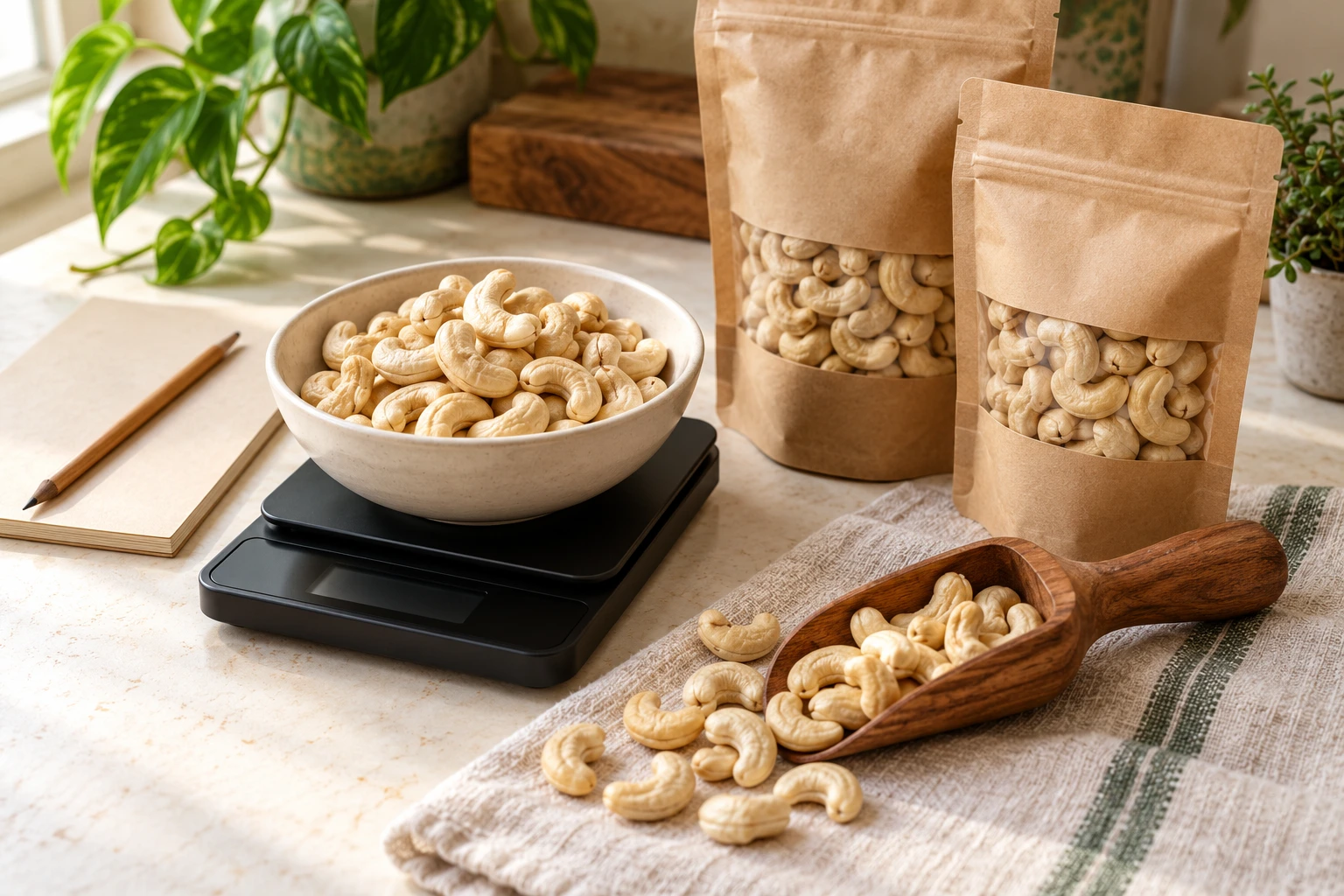
Calculate the dry-fruit cost of each recipe batch
For cooking or baking, record the nuts used in each recipe batch. Include nuts discarded during preparation when calculating the purchase cost for that batch. At ₹770 per kg, 2 kg of cashews costs ₹1,540. Add the costs of other foods, labour, fuel and packing. Nuts kept for another recipe belong in the cost of that separate batch.
Test a different grade using the same recipe and preparation method. Record the amount used, the amount removed and any extra preparation time. Added water changes the finished weight, so record nut weight separately. Pieces used in your kitchen still carry part of the purchase cost.
Check the extra spending behind a bulk discount
A lower rate for 100 kg can require more cash than a 50 kg order. Compare the full payment for both quantities against your expected use. At 20 kg a week, a 100 kg order lasts 5 weeks. Check that you have space to store the full order as instructed.
Pack size affects how much you open at once. For 100 kg, compare 4 packs of 25 kg with 20 packs of 5 kg. Ask which pack sizes are available and how the packing charges differ. Choose a size you can finish within the stated storage conditions.
For almonds, shelf life depends on the product, packaging and storage conditions. Cut and roasted almonds need protection from moisture and oxygen. Ask for the packing date, expiry date and storage instructions before ordering. Check how much time will remain when the order reaches you. Follow the instructions for unopened and opened packs.
Put the price and terms in one order record
Keep one comparison record for each product you plan to buy. Enter the agreed details and keep the record with your invoice. The following fields cover the price and delivery terms discussed above.
| Order detail | What to record |
|---|---|
| Product | Variety, origin if specified, grade, size, whole nuts or pieces, and allowed breakage |
| Quantity and packing | Net kilograms, number of packs and weight per pack |
| Price | Rate per kilo and product total before tax |
| Separate charges | Packing, transport and other stated charges, counted once |
| Payment | GST, total payable and payment dates |
| Delivery | Address or collection point, departure date and expected arrival |
| Price expiry | The last date the supplier will honour the quoted price |
For split deliveries, confirm each quantity and any extra transport charge. Agree how to report missing packs, damage or the wrong products. Ask when to report a problem and which photos or records to provide. Confirm the terms for returns, replacements, refunds or credit against another order.
Check what changed before you reorder
Add the delivered quantity and batch number to your order record. Note differences in the amount you could pack or use. Include changes in packing time, recipe results and any agreed refund.
Before reordering, confirm changes in grade, origin, packing or processing. Update the pack or recipe cost if the buying rate changes. Compare the full cost, including selling and business expenses, with your selling price.
Request pricing for your next bulk order
At NutDana, we supply premium quality dry fruits and seeds in wholesale quantities. Our range serves retailers, food brands and commercial kitchens across India. Request pricing for the products and quantities your business needs.