

How to read the W320 grade code
W identifies the whole-kernel form; W320 is used for a white whole size grade. A whole kernel keeps the characteristic curved cashew shape, with no more than one-eighth missing under the AFI definition. Splits, butts and pieces use other form codes.
320 is a count-size designation, not a millimetre measurement and not the number of kernels in 1 kg. A W320 count test uses 300–320 separated whole kernels in 454 g. The code does not identify the origin, crop year, processing method or pack size.
W320 count per kg and calculated average weight
AFI lists 660–706 W320 whole kernels per kg. Directly converting the 300–320 range per 454 g gives about 661–705 kernels per kg. The small difference comes from the published grading ranges, so use the range named in the purchase specification.
| Measure | W320 figure |
|---|---|
| Estimated count per 100 g | About 66–71 kernels |
| Whole kernels per 454 g | 300–320 kernels |
| Whole kernels per kg under AFI | 660–706 kernels |
| Calculated average weight per kernel | 1.42–1.51 g |
The average weight comes from dividing 454 g by 300–320. It is not a weight limit for every kernel. A 100 g spot count can reveal an obvious mismatch, but it cannot grade a full delivery.
W320 length, width and thickness
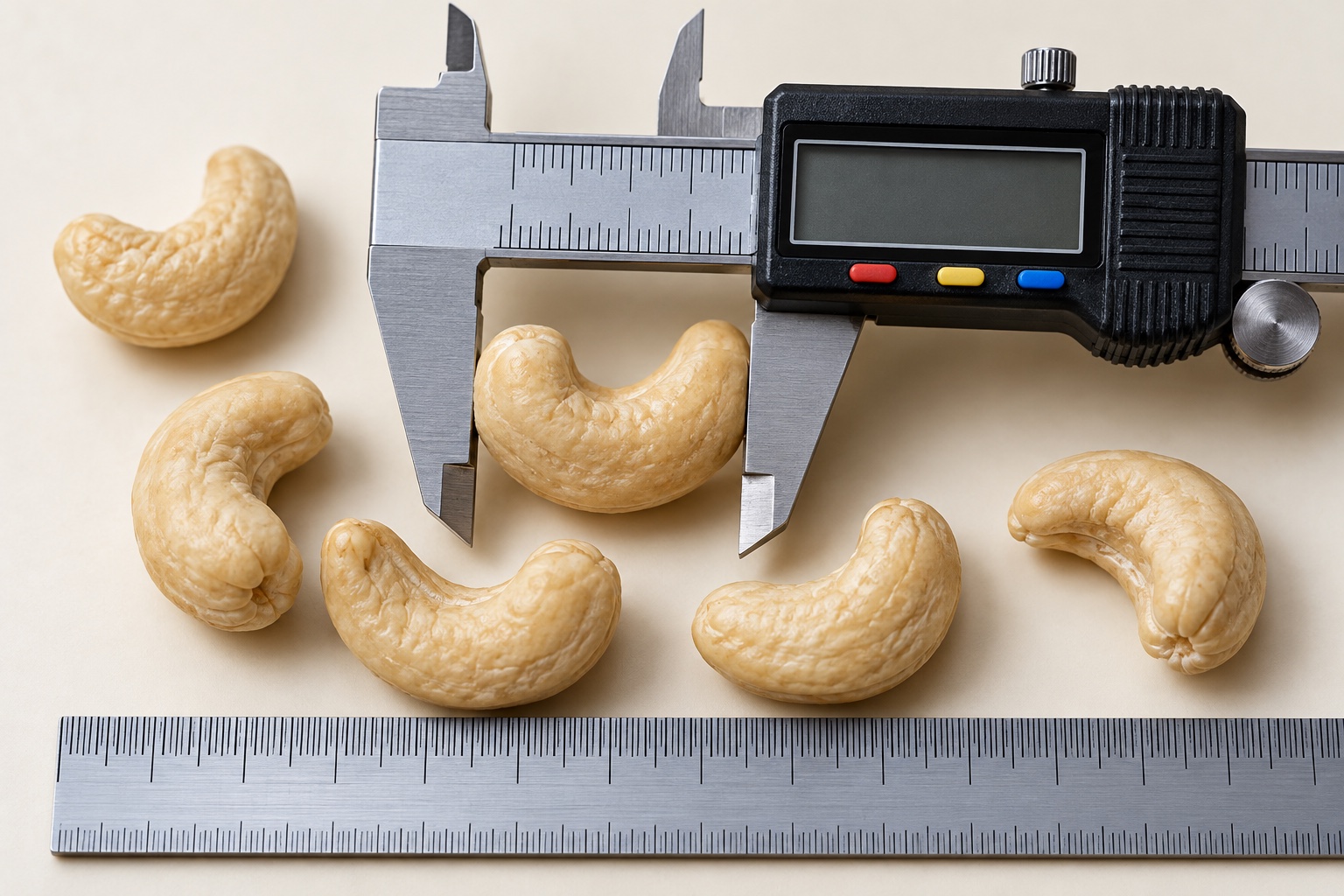
In one published Mangaluru study, 50 W320 kernels averaged 22.5 mm long, 14.1 mm wide and 11.2 mm thick at 5% dry-basis moisture. These are averages from that study sample, not mandatory W320 grade limits.
W320 is graded by the number of whole kernels in a specified weight. Individual kernels can therefore differ in length, width and shape. Grade a weighed sample; do not decide the grade by measuring one kernel.
How W320 compares with W240 and W450
Within the same count system, fewer kernels in 454 g means a heavier average kernel. W240 is larger on average than W320; W450 is smaller on average.
| Grade | Whole kernels per 454 g | Calculated average weight |
|---|---|---|
| W240 | 220–240 | 1.89–2.06 g |
| W320 | 300–320 | 1.42–1.51 g |
| W450 | 400–450 | 1.01–1.14 g |
Count does not confirm flavour, crunch or freshness. Compare those qualities with a representative sample from the offered batch.
Whole shape, broken material and lower-size kernels
Count, broken material and lower-size kernels are separate checks. Count only kernels that meet the agreed whole definition. Weigh broken pieces separately, and record lower-size whole kernels under the method named in the order.
There is no universal broken-kernel percentage for every W320 transaction. AFI allows up to 10% broken material by weight in whole kernels, while the 2025 AICA specification lists 8% for white wholes. Older trade charts may show another limit. Write the standard, edition, sample weight and allowed percentage on the purchase order.
W320 and darker whole grades
W320 refers to a white whole grade. Trade charts may use SW320 or BW320 for a whole kernel in the same count range with darker colour caused by processing heat. Terminology differs between specifications, so do not approve colour from the number 320 alone.
Scorched is a colour-grade term. It does not mean a finished roasted snack. Plain, roasted, salted and flavoured preparations need separate order details.
W320 is a grade, not a cashew-tree variety
A cashew variety can produce kernels that enter several count grades. Tamil Nadu Agricultural University lists VRI 1 and VRI 2 among varieties associated with W320 kernels, but the finished kernels still need sorting by form, colour and count.
Origin and variety do not replace the finished-kernel specification. Ask for them separately when they matter to the order.
Where whole W320 cashews work well
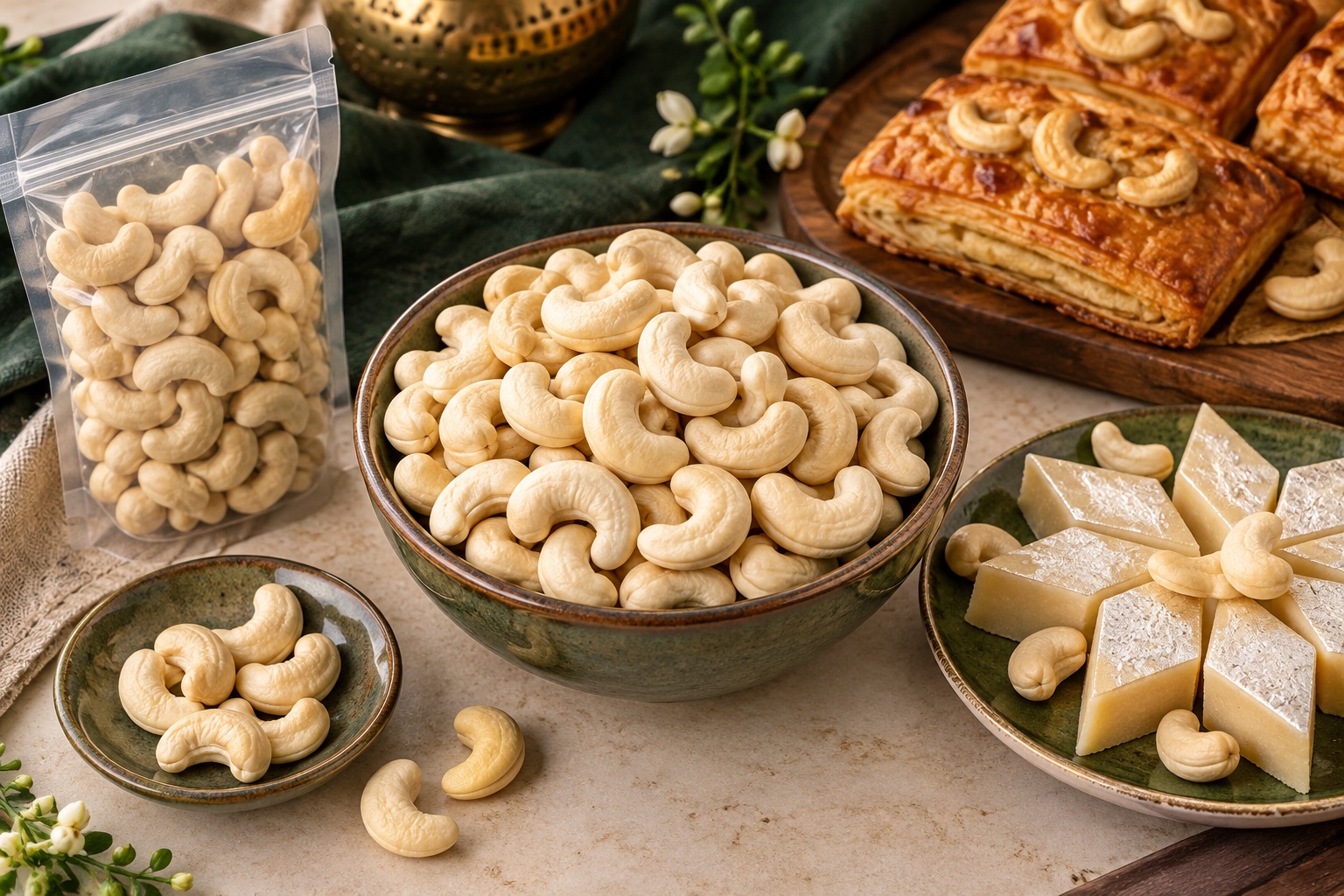
W320 suits products where the customer sees the complete kernel: retail packs, snack mixes, sweets, bakery toppings and garnishes. Its whole shape gives a clear cashew appearance without specifying an extra-large grade.
For paste, fillings or ground recipes, compare split and piece grades. Paying for a whole-kernel grade may not improve a product in which the cashew is ground.
What the W320 code does not confirm
W320 does not confirm the growing country, processing location, crop year, packing date, moisture, flavour, freshness, food safety or packaging condition. It also does not say whether the cashews are plain, roasted, salted or flavoured.
AICA’s 2025 white-whole specification lists a maximum moisture level of 5%, but moisture alone does not prove safety. Reject or isolate packs with mould, live pests, dampness, rancid or stale-oil odour, or damaged seals. Do not taste suspect product.
Cashews can cause serious allergic reactions. Follow the current FSSAI labelling rules that apply to the exact packaged, prepared or raw product, and retain the supplier’s allergen and cross-contact information.
How to check a W320 batch sample
Take the sample from the exact offered batch and from enough locations to represent the delivery. Do not grade a full lot from one convenient handful.
| Check | AFI sample weight | What to record |
|---|---|---|
| Whole-kernel count | 454 g | Separated whole kernels |
| Broken material | 1,000 g | Broken-piece weight |
| Defects | 500 g | Defect type and amount |
Record the batch code, sampling method, sample weight, whole count, broken-piece weight, colour and defects. Match every laboratory report to the same batch code. Keep an approved reference sample sealed when the supply agreement requires one.
Check colour before and after the agreed roast
Inspect raw colour under even lighting. Some marks become clearer after roasting. If finished colour matters, agree one roasting method and compare every approval sample under the same conditions.
Packing and storage checks
On delivery, inspect the inner seal and outer carton. Record punctures, failed seals, dampness, insects and crushed cartons. Correct W320 count does not make damaged packaging acceptable.
Follow the storage instructions supplied for that product. Keep sealed packs away from heat, water, pests and strong odours. After opening, use a clean, dry, food-suitable container with a tight closure. Keep the original label, batch code and dates with the product.
What to write on a W320 purchase specification
State the product preparation, W320 count range, named grading standard and edition, colour grade, broken-material limit, lower-size tolerance, moisture limit, defect limits, net pack weight, packaging, batch identification, sampling method and acceptance process.
Compare delivered cost only after these terms match. A lower price for a different colour, breakage allowance or pack specification is not a like-for-like W320 quote.